





Eye For Film >> Movies >> Dirty Boy (2024) Film Review



Cinema audiences have always been fascinated by cults. The challenge when telling stories about them is that they’re intriguing from a distance but, close up, mostly quite similar, with less glamour than misery. Expecting the cult dynamic to provide all the narrative lift generally dooms a project to failure. In his début feature, which went down well at Raindance and quickly secured a UK-wide release, Doug Rao wisely places more of the focus on character dynamics and on mental illness. The result is a film which, though it’s messy and doesn’t always hit the spot, goes to interesting places.
Unreliable narrators are not uncommon these days, but Rao takes it one step further and presents us with a central character who can’t rely on his own mind. Part of the reason why Isaac (Stan Steinbichler), the ‘dirty boy’ of the title, is seen as unclean is that he suffers from schizophrenic episodes. In his case, these have a dissociative element and sometimes make it difficult to know what is and isn’t real. The stress this causes inclines him to seek stability and reassurance, potentially making a cult a comforting space for him, but he struggled when locked alone in a room for lengthy periods – the audience gets some idea what this is like by way of background narration which comes and goes but is at times so incessant, and only tangentially relevant, that you may well find yourself ceasing to pay attention to the words. This seems to represent the inner voice which , because of his illness, Isaac can’t always distinguish from external sources of information, inclining him to a dualistic interpretation of his own identity.

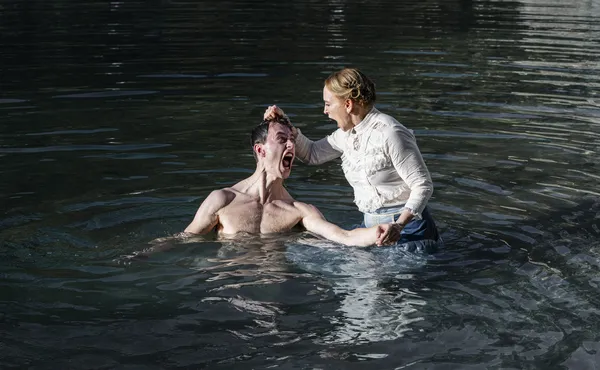
Hope (Honor Gillies), one of the young women in the cult, is afraid that Isaac may be at risk because he has become an embarrassment to its leaders, so she tries to create an opportunity for him to escape. Wandering around the large building where his group lives, Isaac sees things that shock him – sexual things, violent things, immoral things – but how can he be sure if they’re real? Retreating to the safety of his room and, subsequently, to a cleansing ritual which partially restores his standing, he begins an investigation of sorts, prompted by an unexpected offer which leads him to wonder about his own origins.
There’s a Rapture background to the cult, with the attendant notion that the important thing is to be pure on the big day, regardless of how one might have sinned in the past. This puts Isaac in a difficult position as he has urges which may make some viewers very uncomfortable, and it’s not clear that he can always control them. The cult offers him redemption and sanctuary, even a means of liking himself; but despite his own failings, he has a moral core which rejects the things that he suspects are happening there. Hope’s attraction to him – which may itself be shaped in part by her experiences of abuse – makes his situation all the more confusing. Meanwhile, the couple who run the cult warn that the outside world is “filthy with liberalism, pornography and Satan.”
Tangled up with all this are references to aspects of US theology which will make no sense to outsiders who have not taken the time to study it, so you may just have to bear with it. We witness the practice of drinking acidic or alkaline solutions to balance the body (much as in the ancient tradition of humours), and the donning of animal furs for ritual purposes in a parody of shamanism. There are reminders of some of the horrors of the US adoption system. A strict notion of racial hierarchy underlies everything, and the patriarchal system (never a comfortable space in which to be an Isaac) means that the immorality of sexual transgressions is assessed on a completely different basis from that understood by mainstream society. This context allows the film to make some bleak satirical points, but again, its principal concern is with its characters.
What if madness were the ending of a story but a turning point? The film asks us this early on and challenges us to stay with a mentally ill character, to inhabit his skin as he strives to make sense of himself and the world around him. Usually, in fiction, a character goes mad and is then written off, returning only briefly, if at all, to do some impulsive, dangerous thing. Here there is no such relief. There is only life. To resolve his containment and exercise positive agency in the world – to achieve justice – Isaac must reckon with the part of himself that is free.
Reviewed on: 09 Sep 2025




Director: Doug Rao
Writer: Doug Rao
Starring: Stan Steinbichler, Susie Porter, Graham McTavish, Honor Gillies, Alice Lucy, Ava Merson-O'Brien, Afia Abusham
Year: 2024
Runtime: 98 minutes
Country: UK
Festivals:
Search database: