





Eye For Film >> Movies >> Dear Stranger (2025) Film Review


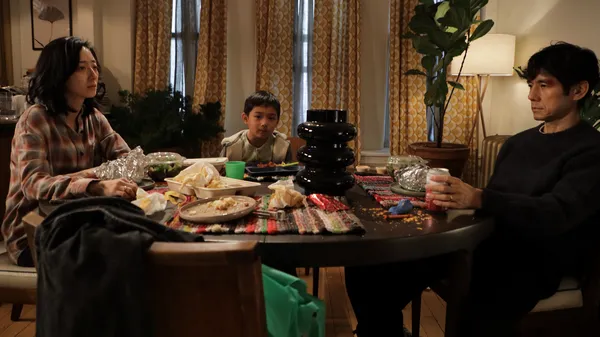

One of the bigger titles to come out of Busan this year. Dear Stranger is a significant film – a first English language venture for Toei Company and an international showcase for two of the biggest talents in the East (Nishijima Hidetoshi of Drive My Car and Gwei Lun-mei of Black Coal, Thin Ice), but it’s a difficult one to reckon with, and the divided critical response to it is understandable. It grapples with big themes in interesting ways, yet falls short when it comes to the details. In some ways it is its shortcomings that make it intriguing – as Nishijima’s character, architecture professor Kenji, might put it, whatever it strove to be has fallen; it is a ruin, and as such it lends itself to myriad interpretations.
Working at New York University and living with his Taiwanese-American wife Jane (Gwei), with whom he does not share a common language, Kenji opens the film with a lecture about the tower of Babel. it might be a way of alerting us to the fact that everything we see here is part of the wreckage of something else. He and Jane once had a happy marriage; now she wonders absently what is keeping them together. The answer must be their little boy, Kai (Everest Talde) – but now that she has ended her period of stay-at-home motherhood, Kai’s position in their lives is changing. Kenji’s suggestion that they have another child seems like an effort to glue part of the ruin back together, to restore the familiar. For her part, Jane feels suffocated by that. She wants to get back to her career.

That career involves directing productions in a puppet theatre. As far as the American dream goes, it’s a step up from her first generation immigrant parents’ small grocery store. Both are contexts in which ethnicity is highly visible, so when the shop is robbed whilst she’s working there, it’s logical to assume that it’s either purely opportunistic or a racist crime, presented to unsettle us, tell us something about her character or explain why a respectable family like this might acquire a gun; it is only later that it taken on an additional dimension.
About a third of the way into the film, there is a scene in which Jane dances alone with one of her puppets, letting out emotions she contains elsewhere. It’s a sensual interaction, almost sexual. Only once will we see her engage with her husband this intimately, and then, perhaps, it will already be too late. The rest of the time she is distant, performing her role in their relationship as if through one of the puppets, held at a distance from her real self. Even when she is angry, desperate, she seems to be screaming at the world in general; his presence is almost incidental.
The reason for the screaming is the absence of Kai. About halfway through, he disappears. The situation as it develops has more in common with real life abductions than with most of those we see in the cinema, and ironically it risks coming across as unrealistic as a consequence, but this enables writer/director Mariko Tetsuya to go beyond familiar landscapes of distress and obsession, to get at some of the more complex and specific feelings at play in this complex scenario.
Though the focus is primarily on Jane for the first half of the film, it is Kenji who develops into the most interesting character. The film itself feels adrift in time and space, never quite pinning down the sensibilities of present day New York, as if Mariko’s vision of it were wholly informed by films and television. This is very much Kenji’s own situation. Jane may be the one who directly expresses frustration with their lack of a shared native language – it is a peculiar detail that neither appears to have made any effort to learn the other’s, and that we hear nothing of the casual babel present in most such households – yet it is he who seems most disconnected from their wider surroundings. Furthermore, as we will discover, he not only feels like an interloper in the city, but in Jane’s relationship with Kai.
The father as outsider is not a new trope but Mariko finds a distinct way to explore it, not simply because of the complicated family circumstances that become apparent, but by way of Kenji’s cultural background. It’s obvious from his actions that he loves the boy, deeply and instinctively (if not always responsibly), but he has a deep rooted sense of inadequacy, of having failed to be all the things he wanted to be for his family, and from this there develops a sense of shame that sees him seeking out an opportunity to suffer, to condemn himself.
Mariko’s focus on this psychology is what makes sense of an ending which some critics seem to have struggled with. it doesn’t really matter what happens afterwards. It is obvious that none of what appears to be established will stick. What matters is his abasement, and his conviction that repairing the honour of his family is more important than the practical matter of being there. It is this cultural difference, rather than simply the linguistic difference, that the Babel story ultimately seems to be referencing. The couple may very well love each other, but when faced with the seemingly impossible task of communicating across this gulf, can that be enough?
A tremendously ambitious film for a director who has never taken on anything on this level before, Dear Stranger was perhaps always destined to fall short, but if you are prepared to watch it on those terms, you will find plenty within it that is interesting and makes the effort worthwhile.
Reviewed on: 11 Oct 2025


Director: Tetsuya Mariko
Writer: Tetsuya Mariko
Starring: Nishijima Hidetoshi, Gwei Lun-Mei, Christopher Mann, Everest Taide, Fiona Fu, Mia Reece
Year: 2025
Runtime: 138 minutes
Country: US, Taiwan, Japan
Festivals:
Search database: