





Eye For Film >> Movies >> Bunny Rabbit (2026) Film Review


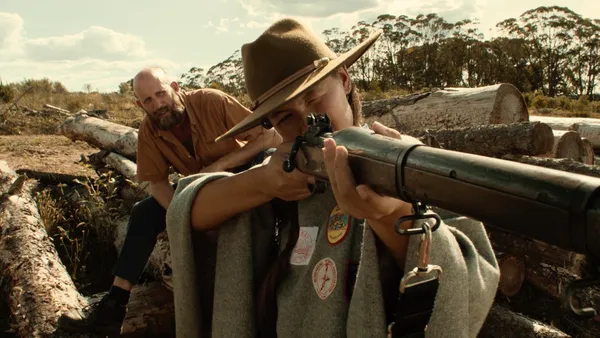

Post-apocalyptic worlds, we are always told, are dangerous for women, and even more so for teenage girls. Everybody with power wants to hurt them. Their best bet is to find one strong man to whom they can trade sex for protection, thereby also doing their duty and giving humanity a future, without regard to the danger of non-medicalised childbirth or what will happen to their daughters. It’s one thing to critique this by asking why anyone would want to live that way, or challenging the romanticisation of it. It’s bolder – and at least as necessary – to ask if it’s realistic. James Branson’s moody, sometimes surreal film posits that when it comes to survival in such a world, what matters far more than a minor difference in muscle mass is something in a person’s character. How adaptable are they? What is survival worth to them? How far are they willing to go?
Beginning with wildfire footage, Bunny Rabbit not only gives us that post-apocalyptic setting but shows us something of how it came to be, presenting an ecological catastrophe narrative which requires no drastic change but instead flows smoothly out of our present day. From Bunny’s father (Andy Golledge) we learn about the collapse, how familiar services gradually just stopped being there; how Jimmy up the road fortified his home with his harem and a collection of young men to hunt for him; how he sat tight and focused on raining his daughter (Kate Wilson). In flashback scenes they wander around ruins together and he tells her tales of the things people used to do in the old world, which make them both laugh. All the time, she’s learning. He teaches her how to fire a rifle. He mentions that he’s heard of some folk resorting to cannibalism, says he’d die before it came to that.

Later, another character will lament being born far too early to make it in this world. As we know from our own, the old generally lack the adaptive capacity of the young. It’s different for Bunny. She barely remembers what they lost. This is her world, and whilst aspects of the way she lives my horrify us, she does everything with a kind of natural grace. She steals fuel. She finds food. She is not easily intimidated. She has blood red dreams.
Sometimes Bunny examines her face in the mirror and one wonders if she's trying to establish what it means to be human. Does she make the grade? Does it matter? There is an awful loneliness to this film, a deep melancholy, but Bunny shakes it off.
It’s about terroir, says her father, borrowing a term from winemaking. About all the different factors that make up the environment: temperature, topography, air quality, and various ingredients of the biosphere. One cannot transplant a vine from one such environment to another and expect it to thrive. Nor can one expect that when a vine is successfully transplanted, the grapes will taste the same.
Branson dispenses with those tired old survivor narratives and casts humanity’s future in a different light.
Reviewed on: 31 Aug 2026