





Eye For Film >> Movies >> Beast Of War (2025) Film Review


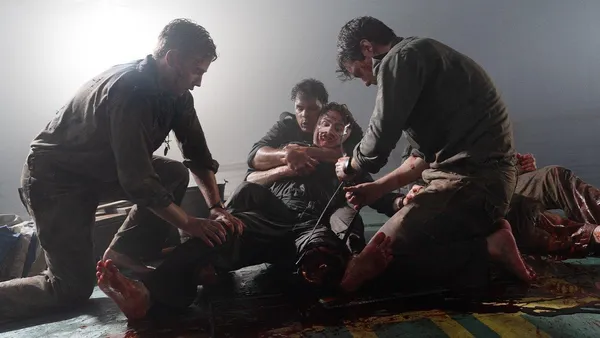

The idea behind basic training for soldiers, aside from team building and developing stamina and muscle, is to teach them how to deal with failure and fear. Of course, soldiers always resist it. They’re most heavily invested in impressing each other. At the first opportunity, the macho posturing comes out, the bravado, the jokes designed to bypass awkward emotions. Despite all the warnings about how war is overwhelming, these lads feel ready to take on the world. Until they see a fin glide through the water. Then there is abrupt, absolute silence.
We spent quite a bit of time with them in the training camp. It helps us to get the measure of who we’re dealing with. Mostly we’re with Leo (Mark Coles Smith), an indigenous soldier who earns a third of what his white mates do and has to put up with three times as much bullshit, but who has swagger enough to be envied by most of them despite it. After a dangerous incident on a run, he takes young Will (Joel Nankervis) under his wing, teaching him to flirt with nurses, and the two form one of those bonds that probably isn’t sexual but means as much as any romance they’ll ever have. It’s a source of assurance for both of them, and no doubt helps Leo to keep as cool as he does when dealing with petulant racist bully Des (Sam Delich).

Setting off to war, all worked up and ready for action, some of them still under the illusion that they’re going to have a good time, they find their plans going sideways fast when the ship transporting them is struck by Japanese bombers somewhere in the eastern Timor Sea. We don’t see much of what happens, probably due to the film’s budgetary limitations, but that’s not a problem – director Kiah Roache-Turner effectively gets across the idea that it’s all too chaotic and overwhelming for anyone to think beyond immediate survival.
Most of them don’t make it out before the ship goes down, but afterwards, on the smooth surface of the water, in a disconcerting fog, those who do grab hold of pieces of wreckage, some lucky enough to find a sort of accidental raft. Naturally, the three mentioned above all end up in the same place. It doesn’t take them long to realise that they’re being circled by a predator. An as it turns out, Leo and sharks have history.
She’s a 20-footer, he reckons, and some Jaws fans will remember how to calculate that. She because, he notes, “the males don’t get that big.” The film’s crew is said to have nicknamed her Shazza, the world’s first bogan shark, but that’s a little unfair. The soldiers ask each other why she keeps following them, why she’s not content to feast on the corpses in the water, but the answer seems pretty straightforward. Sharks are smart. In their efforts to retrieve essential supplies and reach a nearby motorboat, they keep presenting her with interesting puzzles.
With no sign of rescue coming, tension escalates on the raft. Roache-turner achieves a good balance of interpersonal drama and sudden, lurching scares, adding a dash of squaddie-style humour to ease the tension. There are a couple of great one-liners, and a sequence about drinking urine which highlights the unpredictable power dynamics at play whilst delivering ample entertainment.
Naturally, not everyone makes it to the end. Leo works through his past trauma and various conflicts around colonialism and toxic masculinity play out. There are few surprises but there are still some moments of gut-wrenching terror, and the shark-as-metaphor aspect of the film delivers well. Shazza remains mostly unseen, lurking in the depths; when we do see her, our primary impression is of teeth. She becomes the war, becomes the ocean, the all-consuming existential terror with which there can be no reasoning. After all those weeks spent toughening up and imagining themselves as predators, the young men must learn to think like prey to survive.
Reviewed on: 05 Oct 2025


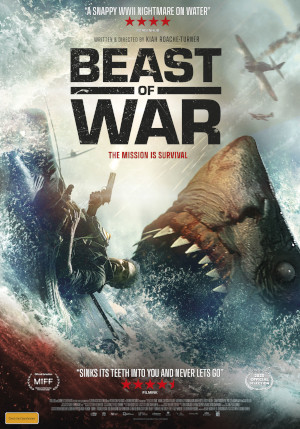
Director: Kiah Roache-Turner
Writer: Kiah Roache-Turner
Starring: Mark Coles Smith, Joel Nankervis, Sam Delich, Lee Tiger Halley, Sam Parsonson, Maximilian Johnson
Year: 2025
Runtime: 87 minutes
Country: Australia
Streaming on: Amazon
Search database:
