





Eye For Film >> Movies >> Beans (2020) Film Review
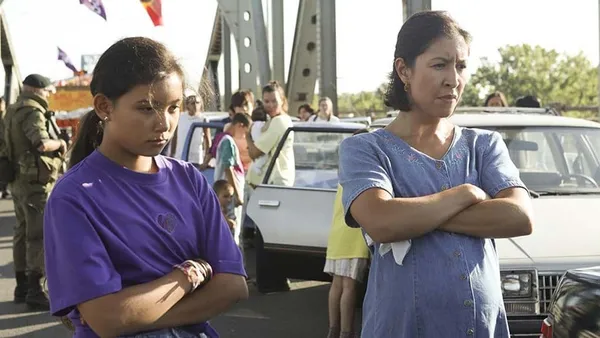

In July 1990, in the Laurentians Valley, Quebec, a dispute developed between local Kahnawá:ke Mohawk people and residents of the small town of Oka. The latter wanted to build a golf course on an adjacent patch of land known as the Pines, which contained the graves of Mohawk ancestors. The resulting stand-off lasted for 78 days and became very ugly at times (future film star Kaniehtiio Horn was among those present, and saw her sister stabbed). Of particular historical significance because of the way it forced Canada to begin to reckon with its treatment of First Nations people at a national level, it has been interpreted in film several times. This latest version comes from co-writer/director Tracey Deer, and, reflecting her own memories of the event, looks at it from the point-of-view of an adolescent girl.
Interviewed at a prestigious art school where she hopes to become a pupil , our young heroine (played by Kiawentiio) introduces herself as Degahandakwa, but after the headmistress fails several times to pronounce it, volunteers “Everybody calls me Beans.” She’s a nice kid, undoubtedly talented, inclined to see the best in everyone, and just a little bit shy so that he father worries about her ability to get by on her own. Her mother is supportive, saying that she must eventually have her own life. Her little sister Ruby (Violah Beauvais) is positive about everything to do with art as long as it has sparkles.
The two girls are out playing together in the woodland near their home when a group of white teenagers arrives there – relaxed, cheerful, anticipated some enjoyable downtime, but still, Beans pulls Ruby into cover. She’s not afraid of white people, or hateful towards them, but she’s wary. Perhaps not wary enough.
Sometimes people who have never been to protests ask why anyone would take children alone. The answers are simple. Most protests are not violent. Children often want to go, especially when they know that the issue affects them. And there isn’t necessarily anyone available to babysit. The Mohawk protest depicted here starts out almost as a community event, with tents at the edge of the trees and tasks that the kids can volunteer for. On the way there, Ruby bounces around in the back seat to (I’ve Got) The Power. But that innocence doesn’t last. The sudden sound of gunshots drives everyone into a panic. It’s just the first of many experiences of violence in which being a child does not guarantee protection, and which lead Beans to realise that she cannot expect the same protections as a white person.
That’s a tough lesson that every young person of colour in a country like Canada has to learn sooner or later, but ideally not when their dad is manning barricades and their pregnant mother is already struggling to cope. Deciding that she will have to toughen up, Beans finds a mentor in neighbour April (the impressive Paulina Alexis) whom any adult viewer can see is more troubled than she is. She learns how to throw a punch but also how to get herself into really dangerous situations which she may not be able to get out of.
The coming of age aspect of the film is fairly formulaic but Kiawentiio’s performance is fresh and awkward in all the right ways, giving it a sense of urgency. Its prosaic aspects make sudden encounters with white mobs all the more terrifying in contrast, and Beans’ own experiments with using violence add some complexity to the situation. Deer’s direction may mostly be formulaic but she makes good use of archive footage to remind us, at key moments, that what we’re watching isn’t far from reality. Meanwhile there are enough fictionalised aspects to the story to keep viewers uncertain of the outcome. Screened as part of Fantasia 2025, it’s an effective depiction of the impact of inter-community violence on children, and it adds a fresh element of horror to the story for viewers of any age.
Reviewed on: 07 Aug 2025


Read more Beans reviews:
| Amber Wilkinson |    |
Director: Tracey Deer
Writer: Tracey Deer, Meredith Vuchnich
Starring: Kiawentiio, Violah Beauvais, Rainbow Dickerson, Joel Montgrand, Paulina Alexis, D'Pharaoh Woon-A-Tai, Jay Cardinal Villeneuve, Taio Gélinas, Caroline Gelinas, Dawn Ford, Kelly Beaudoin, Brittany LeBorgne, Ida Labillois-Montour, Adam LeBlanc, Emilie Paquet
Year: 2020
Runtime: 92 minutes
Country: Canada
Search database:
