





Eye For Film >> Movies >> 2000 Meters To Andriivka (2025) Film Review



Andriivka's name is shared with several other places, transcribed variously from Ukrainian or Russian. The closest version of 'Andrew's Town' in English is maybe Anderston. There's one of those in Glasgow, almost indescribably more populous than the village in the Donetsk Oblast. Anderston's famous inhabitants include Sir Billy Connolly, Eddi Reader, Tony Roper, among a list long enough that it was possible to select those who've had multiple screen appearances from notables that include politicans, playwrights, and a Nobel laureate.
2000 meters is given context too. About ten minutes' run, the film says; half that (4:43.13) if you're an Olympian recordholder. A few minutes' drive, just over a minute at UK motorway speeds. We see the moon in variously obscured skies. At one point Apollo 8's crew were covering that distance five and a half times a second, their craft, unnamed, making them the fastest men alive. It was also potentially of a vintage with some of the vehicles ferrying troops towards Andriivka, as much a shape harking back to the jet and space ages as the BTR-87 with its design heritage from the mid-Fifties. They're used rarely though. It takes a mortar shell 35 seconds to cover the distance. The landmines are already there.
I cannot adequately represent the hell that is in those two thousand meters. Seven layers for Dante, but more than that of detritus, debris, shell casings and the shell shocked; dust becoming, and which once was, mud; flames, shapes that suddenly coalesce into corpses. A century and a decade or so after 1917 and the landscapes are the same. Trenches and foxholes. The rifles are differently shaped, some of the cigarettes are hand-rolled, others electric; the uniforms bear a mixture of flags and tape and patterns, and the hair is different but these too are men who shall not grow old and we are with them to the end.
Mstylav Chernov's film 20 Days In Mariupol is of the city under siege; this is a counterattack, an advance along a forest towards the village. 'Forest' is a rich descriptor. It is an area of woodland beside a road, the trees marking the boundary between two swathes of agricultural land that are now minefields. The ground on either side bears craters in such numbers that it is only the wet and green that indicates they are not lunar. "Imagine a planet," to paraphrase one of the quoted soldiers, "where everything is trying to kill you".
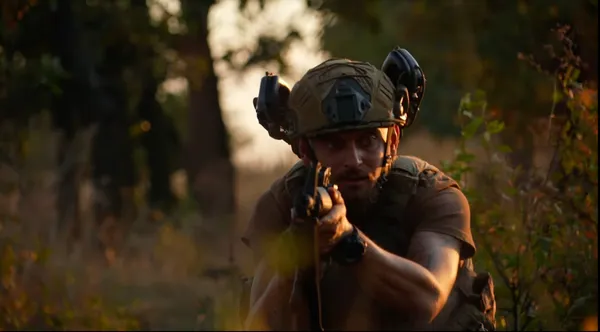
The helmet cameras are part of a long cinematic tradition, long before Aliens they were being used in sports films and there's pictures of Steve McQueen with one taped to his helmet during Le Mans. While Chernov is embedded in the last push we go back to earlier fighting through what soldiers saw. The smoke, the blasts, the spinning of ejecting shell casings, yells that become cries, the front-line as it becomes frantic.
One of the frequent shouts is "FPV," subtitled as 'suicide drone' but derived from the initialism for "First Person Video". Documentary is often intensely personal and Chernov tells the story of the day the Ukrainian flag is raised over Andriivka with his own boots on that ground. Even more personal is what Chernov and editor Michelle Mizner have carved out of the footage taken by 14 members of the 3rd Assault Brigade. Their callsigns, nommes du guerre, are in the credits, and they are present in memory.
The helmet cameras feel almost like a videogame, with impossible resolution. The mixture of makes and models, the litany of lethalities, every soldier's pack bedecked with a chandelier of mismatched gear, a set of statements about circumstance and situation. Uniform only in aggregate, a through line only because one is drawn.
These first person perspectives put us behind the guns, down with the mud, among the branches and the shrapnel. It is not a comfortable watch. How could it be? If Civil War were a film whose platitudes about observing and being changed meant it failed to be an anti-war film then here we have a film that confronts those questions differently. This fighting is what Ukraine is doing to defend itself against an aggressor. There have and ever will be meditations on the cost of violence and its attractions. Though there are two parties involved these are not duels. The numbers are between pairs and classrooms. It is not that there feels any falseness in what's shown but that there is a distancing brought about by things like Sam Slater's score. That might be a comfort to the audience, a retreat from reality.
The comparison to videogames is a retreat to the known, that these are perspectives that have previously been fictional made flesh, frail and fraught. The moderation of music masks moments of mortality and that intermediation pulls audiences back a little, makes it a little safer. No such comfort for those depicted, most younger than an independent Ukraine, even the grandfather among them too young to have voted for it. They are making the choice to defend it though, and the least one could do to help them is watch.
Reviewed on: 05 Aug 2025


Festivals:
Sundance 2025Doc/Fest 2025
Docs Ireland 2025
Karlovy 2025
Black Nights 2025
DOC NYC 2025
Palm Springs 2026
Search database: