John Travolta has had more comebacks than a boomerang as his career has swerved between the highs of Pulp Fiction and Primary Colors and the lows of Battlefield Earth and others too numerous to mention. Born to a large Italian-Irish family in Englewood, New Jersey, Travolta has been on the acting scene for most of his adult life. He first gained success in the TV series Welcome Back Kotter but it was at the age of 24, that he became an international superstar with Saturday Night Fever, followed a year later by the box office hit Grease. With his appearance at the Karlovy Vary International Film Festival in the Czech Republic he seems to be in a good place. Richard Mowe met him before the premiere of his latest film Killing Season in which he plays opposite Robert De Niro.
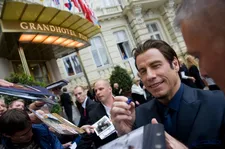 |
| John Travolta obliges autograph hunters in Karlovy Vary. |
Richard Mowe: How do you look back on the good, bad and ugly moments of your career over more than three decades?
John Travolta: You have to understand my origins. I come from a working class family. We did not have a lot but we did have access to the arts. Any ups and downs professionally were not significant to me. My personal losses and there have been many, did impinge on me. I love movies but they are not life, but they are part of life. I have been fortunate I was able to do them but I do not have a dramatic feeling about the highs and lows.
RM: How was the experience of partnering Robert De Niro in Killing Season?
JT: I knew Robert De Niro from many years ago, when he was setting a trend in the States for a different kind of acting. His way was that if you portrayed a character you became that role by studying and gaining inside knowledge. For Raging Bull, he became a boxer. For Saturday Night Fever, I decided I had to become a real dancer and I trained for seven months. De Niro started a new wave of acting and I had to wait for 37 years to finally work with him but it was worth the wait.
RM: What made you accept the challenge of appearing in Killing Season?
JT: This movie set during the Bosnian conflict was on a list in Hollywood called the Black List and it kept being shunted around. I loved the message of the script, and the challenge of the character. It seems in contemporary cinema that comic strip extravaganzas rule, but that is not really my thing. You have to seek out the kind of movies that I grew up with. This was a rare opportunity, and it reminded me of Born On The 4th Of July and Coming Home in the way it examines the mental state of people forced to be in conflict and have to commit war crimes. I cannot imagine what they had to suffer.
 |
| A face in the crowd. |
RM: Was it easy to make the transition from musicals to more serious fare?
JT: For me, it was easy to do the transition. I grew up in a family of actors and we were always challenging each other to be different characters in different scenarios. It is common in New York that sometimes you do a musical, sometimes you do a drama. So there were no big issues around it.
RM: You were close to the late James Gandolfini. What was the connection?
JT: My father sold automobile tyres to his father when we were younger. He would see my photograph in the store window and it inspired him to become an actor. We ended up doing five movies together. When my son passed away, he would not leave the city until he felt I was OK. It is unusual for another actor to have that depth of feeling. But when he was going through a divorce and we were shooting a small film with Salma Hayek, I told him and I loved him the moment I saw him and I hoped that it explains it a bit. He cried but at that moment he did need to cry.
RM: Would you consider turning to directing?
JT: The only movie I would consider directing is a short – about a semi-auto-biographical book I wrote called Propeller One Way Night Coach about a young boy who travelled across America in the 1950s. I would want my son to play me and my wife [actress Kelly Preston] to play his mother. The job of directing is 24/7 and I have too much else going on in my life.
RM: Have you always been able to put the tough times aside?
JT: I have because they weren’t so tough at the time. I was still always working. I just wasn’t working on major projects. But I always had a job. I was also interested in other things. I studied jet aeroplanes and became a pilot. I studied Scientology. So I had things to do that occupied my time plus I worked at least once a year in a movie of some sort.