





Eye For Film >> Movies >> The Isle (2000) Film Review



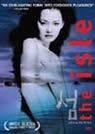
Following the controversial Bad Guy, Ki-duk Kim's The Isle is a gentler take on the themes of isolation and obsessive love, though it contains some still more violent scenes. Set around a lake where fishermen inhabit floating shacks, it explores the relationship between suicidal newcomer Hyun-Shik and Hee-Jin, the woman who runs the lake's shop and, with her boat, controls access for everyone. Though we see her early on engaged in prostitution and being treated badly, it gradually emerges that Hee-Jin is the most powerful person in the vicinity, and, with the constant rowing she does, physically a match for anyone. This independence disturbs and intrigues Hyun-Shik in equal measures, and what develops is a violent sado-masochistic relationship in which both characters struggle frantically against losing their independence to love.
The urgency of this central relationship is underlined by the fact that Hyun-Shik has a past he doesn't want to talk about and Hee-Jin is apparently mute (though we see her talk on the telephone, suggesting that her lack of verbal communication in the lake environment is willful). Unable to discuss the world beyond the lake, or how they came to be there, these two characters live entirely in the present tense. Their communication is entirely physical. Through mutual self-destruction, they briefly create an island of love within a brutal world, though, ultimately, each is an island alone. The lake itself might be seen as an island, apparently cut off from reality, open to extremes. Threats from the outside are managed in a peremptory fashion, as if Hee-Jin is barely able to countenance their relevance to her world.

Despite the limited dialogue, The Isle never drags; events occur with little heed to the passing of time, yet the underlying tension never slackens its grip. The whole thing is beautiful to look at, and the sound matches the quality of the images, evocative and involving. This artistic endeavour is, in turn, balanced by Mr Kim's dry sense of humour. There's plenty to amuse, but the director's great achievement is to ensure that the audience are never sure whether to laugh or not, adding to the film's disturbing quality and to the intensity of its emotional impact.
The Isle is not a film for the masses, and many may find it frustrating or just too unpleasant, but it is a masterpiece of its kind, and it has at its heart a beautiful love story. The ambiguous ending leaves it open to numerous different interpretations, most notably with its conflation of Hee-Jin with the boat-spirits of Korean legend, protectors of mariners. This is a bold, intriguing and complicated film which will linger in your imagination for a long time.
Reviewed on: 03 Oct 2006



Director: Kim Ki-duk
Writer: Kim Ki-duk
Starring: Suh Jung, Kim Yoosuk, Park Sung-hee
Year: 2000
Runtime: 88 minutes
BBFC: 
Country: South Korea
Festivals:
Search database:
