





Eye For Film >> Movies >> Belle De Jour (1967) Film Review


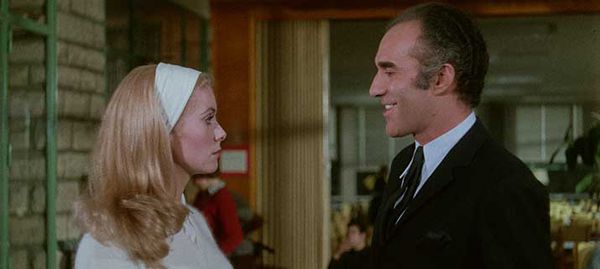
Severine (Catherine Deneuve) is a bored, affluent housewife. We meet her first when she is forced to dismount from a carriage. Her husband Pierre (Jean Sorel) ties her to a tree, whips her, then leaves her to be raped by the two carriage drivers.
Severine is prone to fantasies. She is in a conventional marriage. Pierre is a handsome young surgeon. They sleep in separate beds. An older friend, Henri, keeps hitting on her, but she tells him to keep his compliments to himself. He is attracted by her blonde perfection, her virtue and her icy disdain.

Taking fantasy a stage further, Severine gets a daytime job at a high class brothel. At first she is prudish and wants to pick her clients. Then she is shown 'a firm hand' - which the masochistic side of her nature relishes.
Re-released almost 40 years after its original cinema exhibition, Belle De Jour still has the power to shock. Not through explicit nudity (it is a highly erotic work without being titillating) but by the shocking images and the superb performances that contrast the aloofness of the bourgeoisie to the practicality of sex, of elegance to depravity.
Scenes of Severine having mud thrown at her stick in the mind no less than the tentativeness with which she approaches the brothel for the first time, dressed in black, and ready to take flight at any moment. Couture by Yves Saint Laurent and lush photography drown us in luxurious chic. The stylish settings arouse our aesthetic senses, and the languorous pacing and emotional complexity keep us trying to figure it all out long before we realise just how difficult that is going to be.
Analysing the film in Freudian or purely sexual terms is less than satisfying. The characters are convincing - the posh conservative elite, the matter-of-fact but certainly not coarse madame, the pervs who visit the brothel, and the psychologically conflicted Severine.
It is hardly a plea for sexual liberation - the men, even one that Severine takes a fancy to, are pretty lowlife. Their strange fantasy requirements mete out the most fascinating tableau of perversions but even more fascinating is what we don't see: such as what is in the box brought by the Chinaman. We are forced to identify with Severine - she is the most normal character - and yet the most convincing way to approach the film is one suggested by Bunuel himself, as a parable attacking the decadence of the bourgeoisie.
On a more elevated level, it is a forceful artistic statement that viewers addicted to linear storytelling may find hard to accept. It seems to anticipate Eyes Wide Shut in its treatment of hidden sexuality, but cinematically it is more linked to the surreal Mulholland Drive.
Bunuel's friend from University and sometime collaborator, Salvador Dali, could be similarly perplexing when it came to alternate realities. He said, "People love mystery, and that is why they love my paintings." The mind is drawn to interpret a piece of art in a concrete way, but the artist may wish to express a concept that transcends specific examples. In Belle de Jour, Bunuel claims that there are not two endings, just one ambiguous ending. When you have finished watching the film it is not hard to decide which scenes are reality and which are fantasy, but when you run it through your mind again it is equally possible to make alterations. Do we want to know what is in the box, or do we love the mystery?
The name Belle De Jour can be read as a pun 'lady of the night', since Severine only worked in the day; everything becomes plain. This is maybe why it becomes her as her name at the brothel. But enter Severine's feverish imagination and you might see something else.
Reviewed on: 30 Dec 2006




Director: Luis Buñuel
Writer: Luis Buñuel, Jean-Claude Carriere, Joseph Kessel
Starring: Catherine Deneuve, Jean Sorel, Michel Piccoli, Genevieve Page, Pierre Clementi, Françoise Fabian, Macha Meril
Year: 1967
Runtime: 101 minutes
BBFC: 
Country: France/Italy
Search database:
