





Eye For Film >> Movies >> Machuca (2004) Film Review

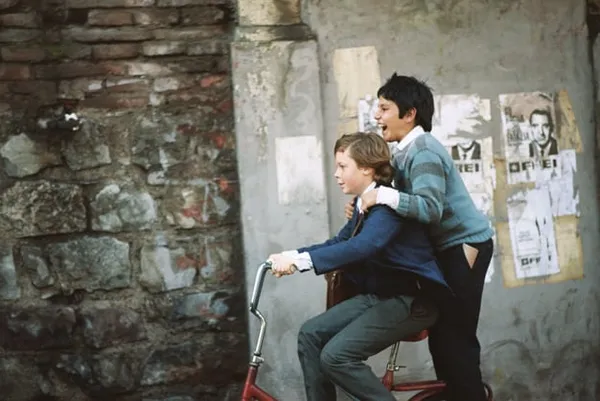

In 1970s Chile, arguably the first Marxist country, President Allende is in power and, in its capital Santiago, the liberal padre of an English school, Father McEnroe, attempts an ambitious social experiment by introducing students of different classes and social backgrounds.
This is how Gonzalo Infante, the shy boy marked out by his ginger hair and "strawberry face", meets Pedro Machuca, the streetwise kid from the slums across the river. United against bullies, they form a bond of friendship and experience each others' lives: Gonzalo's aspiring mother and rich lover, idealist father and spoilt sister; Pedro's drunken father, enterprising uncle and alluring cousin Silvana. However, growing civil unrest and their relationship with Silvana tests - and ultimately breaks - their rapport, leaving both feeling betrayed by their country and each other.

Andres Wood's film is a passionate, almost angry look at events often forgotten in world history, a regime physically crushed by a military junta, but primarily crippled by class divisions and bitterness. By focusing attention on his young leads, he manages to keep a fairly apolitical viewpoint, instead concentrating on the everyday lives of Pedro and Gonzalo, using the political situation as a backdrop.
Gonzalo's upper-middle-class life is seen in many ways to be worse and more uncertain than Pedro's and he seeks a new life with the substitute family of Pedro's uncle and cousin.This leads to ironic scenes of the three youngsters quickly swapping between selling flags at both nationalist and commuinist rallies.
The relationship between the boys and the older Silvana is touchingly handled and actress Manuella Martelli is a revelation, with a fiery provocative performance that would make condensed milk sexy. Mathias Quer, as Gonzalo, is also excellent, his impassive face mirroring the blankness of his life, only to change in a climactic scene to a warped mixture of sadness and joy at having escaped, as he rides away from the destruction of the shantytown.
Politics still creeps in, through sly references to its connection with football and the Lone Ranger's portrayal of cowboy and indians. It is supplemented by sequences of the marches, which crackle with venomous electricity, and the grey tones and lively sounds that evoke the Seventies culture.
Each character reflects a different political viewpoint and it is clear that none stands alone as the correct one. This is a powerful piece - more sombre in tone than City Of God, more down to earth than The Dreamers.
Another masterpiece of South American cinema.
Reviewed on: 26 Aug 2004



Read more Machuca reviews:
| Nick Jones |   |
Director: Andres Wood
Writer: Andres Wood, Roberto Brodsky, Mamoun Hassan
Starring: Mathias Quer, Ariel Mateluna, Manuela Martelli, Aline Kuppenheim, Ernesto Malbran, Francisco Reyes
Year: 2004
Runtime: 120 minutes
BBFC: 
Country: Chile/Spain/UK/France
Search database:
