





Eye For Film >> Movies >> Tunnels: Sun In The Dark (2025) Film Review



Last year work began on turning the Cù Chi district of Ho Chi Minh City into a specialist administrative area. 53 years ago it served a similar purpose, but in a very different way. Much of the tunnel network that existed then, laboriously dug out by hand by members of the National Liberation Front of South Vietnam, is still in existence beneath the city, though it’s unlikely that it will all survive the new phase of construction. What will survive for a long time to come are stories of the role it played in shaping the country, in part thanks to this film, which screened as part of Fantasia 2026.
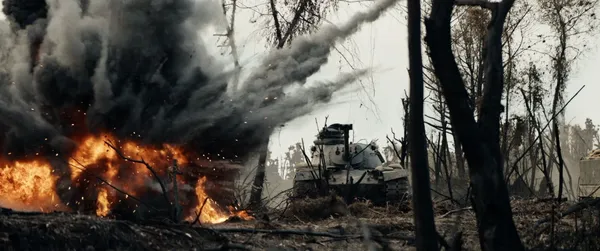
Although it uses parts of the original tunnel complex for its sets, Bùi Thac Chuyên’s film mixes these with rural locations where burned and butchered trees cling to muddy ground much as they did after American assailants denuded the landscape during the war, trying to leave their opponents with nowhere to hide. Of course, when tree cover is lost, undergrowth suddenly receives a lot more light, and blooms, providing new hiding places which skilled fighters who have grown up in the area can move through just as effectively. We also learn how they collect the canisters in which napalm is delivered because these can be traded for food with villagers, enabling them to hold out for longer.

Opening onto a river, the tunnels also allow members of the military unit we follow to move in and out under the water, or just at its surface, concealed by patches of floating vegetation. This is particularly valuable because the Americans use the river as a transport corridor, so their movements can be easily monitored. It also means that the tunnels are constantly damp. Reading the history of the conflict, one encounters a good deal about the vermin, parasites and diseases which troubled the tunnel residents as a result. Chuyên steers away from this, however, disinclined to layer on the suffering. Instead he focuses on the fear and self-doubt that the soldiers experience, their grief over fallen comrades, and the sense of hopelessnmess that sometimes overwhelms them when they don’t really know what they’re doing there.
Vietnamese viewers who have paid attention may very well knowc what they’re doing there, because what Chuyên has adapted and partially fictionalised was a far from insignificant part of the war. As the group’s leader, Bay Theo (an impressive Thai Hoa) also knows, but he is sworn to silence. Most of those serving under him are very young (as are the Americans we see from time to time) and he must be a father figure to them, keeping their morale up, trying to keep them out of trouble, disciplining them when necessary and taking responsibility when they don’t know how. They have a deep trust and effection for him but he also has to put up with their tantrums and find solutions to problems he really shouldn’t have when they make the mistake of assuming they know better.
This is an ensemble film and nobody has a monopoly on heroism or folly, but over time, some characters stand out. Troubling from the outset is the presence to Tu Dap (Quang Tuan), an apparent deserter whom he has to consider a possible spy, but whose engineering skills, along with an overall impressive level of competence, make it tempting to take a chance and hold onto him. Pleading for this is Ba Huong (Thu Ahn Ho), a young woman whose impulsiveness means she can also be a problem, but whose toughness, courage and loyalty to the cause helps to inspire the others. Then there is Ut Kho (Diem Hang Lamoon), gradually losing her mind under the constant strain and, in the process, acquiring an all too visible vulnerability within the unit; and Luc Tac (Anh Tu Wilson), whose mixture of innocence and volatility predisposes him to make bad decisions.
Embedded as we are within this unit, in the intimate environment of underground bunkers, it’s easy to sympathise with the soldiers regardless of one’s political persuasions or historical perspective. Like all the best war movies, Tunnels is rooted in the understanding that these young people and first and foremost fighting to stay alive and to protect or avenge their friends. It’s easy to identify the Americans as the bad guys given their massively superior technology, but Chuyên also makes room for empathy with US tunnel rats in a couple of scenes where their fear is palpable as they slide through narrow openings into uncharted enemy territory. There are moments when Bay rallies the troops with speeches about how this is the people’s war, but they are not overplayed, and in sum the film is a lot less heavy-handed than the big name US takes on the war.
The film is heavy on action, mostly in short bursts due to the style of fighting (brief attacks followed by retreat underground), but effective nonetheless. Those less familiar with the history will find the innovative tactics used by the Vietnamese soldiers particularly exciting; and there are some seriously scary moments with tunnel collapses and flooding. K’Linh Nguyen’s cinematography brings it all vividly to life: the flicker of lanterns around hidden bends, the serenity of underwater landscapes as violence takes place up above, the bullets ricocheting between the trees like dancing fireflies in the night. As he shows us what, Chuyên also shows us why.
Reviewed on: 17 Jul 2026