





Eye For Film >> Movies >> Mr. K (2024) Film Review


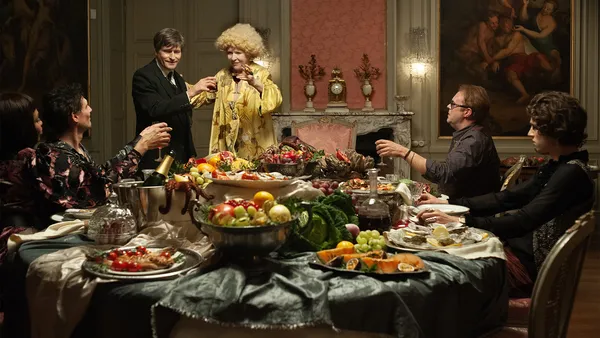

The stage magician’s craft is a tricky one. He would starve without attention, but too much of it and all his careful constructions come to nothing. People go to see him knowing that he’s a liar but wanting to be fooled, and if he fails to fool them, they will hate him. His gift is the illusion that the bounds of this world are not as tight as they might seem – that there is more to it all. He, however, must always face the truth. There is no escape. The performance is all. In his grave he will lie still.
Mr. K (Crispin Glover) is not particularly successful, as magicians go. The audience for which we see him perform does not seem absorbed by the show, and neither does he. Later, in daylight, approaching the building where he will spend the rest of the film (and which, despite its rather greater height, might be taken for an avatar of Franz Kafka’s Castle), he stumbles and his eye is momentarily caught by something moving between the uneven stones of the mossy courtyard. A line of ants is parading around there, fixated on some inscrutable purpose. He lifts one up to examine it more closely, and the others carry on. The disappearance of an individual does not disrupt the process.

The choice of hotel as setting is a good one. They don’t make ‘em like they used to, but if you’ve ever stayed in one of those vast late 19th Century or early 20th Century places that sprang up in resort towns and were as swiftly abandoned by most of their customers when the tides of fashion turned, you too may have experienced a brief moment of panic as, having dutifully followed a concierge to your room without giving the matter much thought, you realise that you have absolutely no idea how to find your way back to the elevator or stairs. In the UK these days, thankfully, signs are obligatory, but that’s not the case everywhere. Here, signs are more like auguries. Mr. K is lost, and for the time that remains, that is how it will stay.
What happens to a man when he knows that he is lost? This is perhaps writer/director Tallulah Hazecamp Schwab’s primary concern, as we watch Mr. K gradually come to terms with his predicament and become ever more inventive in his search for solutions – yet she is also interested in how he understands and relates to all those other hotel residents who have long ago stopped caring. Many seem to have lost all perspective, to be scarcely aware that a world exists beyond the walls, let alone willing to countenance Mr. K’s theory that the walls are closing in, that they are running out of time. Over time, however, some of them come to regard him with curiosity. Conspiracy theories swirl amongst them. Could he, rebellious and resistant to reason, be a prophesied figure come to set them free?
Right from that opening scene at the show, production designers Manolito Glas and Maarten Piersma do a stunning job with the sets, creating an atmosphere of sleaze and decay which one can almost smell, whilst layering in detail. As the story goes on, we see the building deteriorate further and further, until the walls are thick with moss and there a rabbits scampering through the corridors. of course, the obligatory rooster also struts his stuff. Surrealist referentialism aside, somebody has to be keeping the hens excited, because Mr. K spends a fair part of the film in a restaurant kitchen which deals exclusively with eggs. There the sous chefs and assistants, in the tradition of their class, wake up early to toil for no discernible gain before spending their nights in drunken cacophone, threating to drown our floundering conjuror like a culinary Wake in Fright.
Glover is well cast, with the right combination of everyman qualities, clumsy innocence and spiky edge. His character notes, on entering, that the receptionists’s potato-shaped bulldog doesn’t seem to like him; perhaps it senses an inherent difference. The magician, as is his wont, seeks progress, seeks to steal the secrets of the gods; but anyone who knows that story well will appreciate that only a fool can truly escape.
The display is all about distraction. It needs to be. Some tricks are slow in the build-up, and the audience can become bored, distracted, even depressed. Schwab doesn’t offer us the conventional ruse of beauty, preferring to dazzle with the illusion of complexity, or simply with ideas. Some viewers will already be too familiar with this. They will see through to the mechanics of the thing and walk away feeling a little underwhelmed, a little less enamoured with the world and its potential. Those who look less closely will see more, and, perhaps, experience the magic.
Reviewed on: 24 Oct 2025


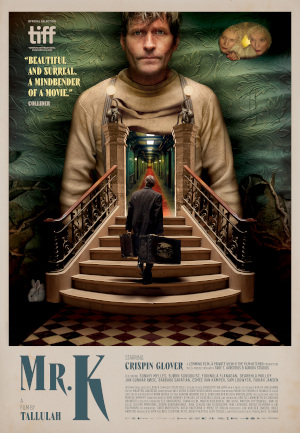

Director: Tallulah Hazekamp Schwab
Writer: Tallulah Hazekamp Schwab
Starring: Crispin Glover, Sunnyi Melles, Fionnula Flanagan, Bjørn Sundquist, Dearbhla Molloy, Barbara Sarafian, Jan Gunnar Røise, Esmée van Kampen, Sam Louwyck, Josse Colsoul, Dominique Dauwe, Wito Geerts, Joshua Gabriel Liège, Yassine Ouaich, Klaartje Pedersen
Year: 2024
Runtime: 94 minutes
Country: Netherlands, Norway, Belgium
Search database:
