





Eye For Film >> Movies >> Human Tide (2025) Film Review


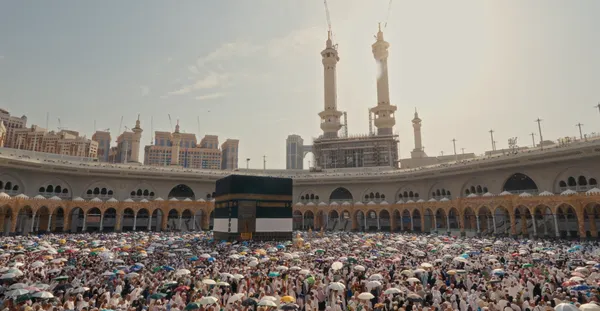

The closing film of the 2026 Muslim International Film Festival, this gentle examination of what it means to undertake the Hajj in the present day stands out from the start. Whilst most of the films at this showcase are set in hot countries, here we begin in a wide field of snow. It’s an immediate challenge to stereotypes, a reminder of how far dar-al-Islam extends, and an indicator of the scale of the journey many pilgrims face.
This is Luleå, Sweden, where we meet a man who talks about how his life was shaped by his parents’ divorce; how he suffered from depression, lost and then regained his faith, and hopes that the Hajj will help him heal for good.
His story is one of many told in this documentary, and it typifies the hopes expressed in others, whereby people broken or bruised by the vicissitudes of ordinary life endeavour to step outside it and enter a different way of being in order to find solutions. This doesn’t compete with the spiritual aims of the Hajj; rather it is part and parcel of their experience of being closer to the divine. That said, it is not an easy thing to accomplish. Finding the money and untangling oneself from work commitments is one thing. Finding a way to set aside family commitments is harder. We see how this weighs on a father whose daughter has suffered health problems since birth, and who is deeply devoted to her.
For outsiders not familiar with such a calling, the decision to prioritise the Hajj to this degree may be hard to grasp – but the film, directed by a non-Muslim, does a very good job of explaining this, not by preaching but simply through what it shows us. The change we see in the various pilgrims over the course of their journey shows the value not just of religious commitment but simply of separating oneself, for a little while, from worldly concerns, freeing up the imagination and making room for a different perspective on life. Joining a community whose every member is committed to this kind of growth and awakening provides powerful reassurance. Finding faith, not only in a set of ideas and rituals but in the possibility that things will work out for the best, makes room for emotional healing.
The Hajj is strenuous, physically as well as emotionally. Several of the people we follow are in poor health. We see how family members come together to support one another through it. One woman whose father was never able to take her there is finally able to make the journey in the company of her young adult son. She is overwhelmed by the crowds, but he is told that if she can’t cope, he can carry out some elements of ritual on her behalf. One is reminded that Islam was making provision for people like this centuries before the West discovered reasonable adjustments.
Practical aspects of production mean that most of the pilgrims are from the director’s native England, but we also meet a man from Kenya who is organising a group trip, plus a couple from Mukono, Uganda, who want to pray for the child they have been unable to produce in nine years of marriage. Ugandan culture places a heavy focus on the importance of reproduction, and they have broken with convention by staying together in spite of this, having one of those rare relationships where love just shines out of them even after so long. What they discover enables them to reframe their experiences. Meanwhile, a police officer and a medical student are inspired, in different ways, to work on becoming role models, so that they can undermine prejudice and better serve the public.
A lot might be said about how the Hajj has changed over the years, how commercialised it has become, but director David Andrew Ward is not interested in this; nor has he created a how-to guide. His interest is very much on the spiritual side, and here he is aided by Ryan Al Bishri’s sublime cinematography, especially in capturing those aspects of the landscape around Mecca which truly feel eternal. Although it is weighted towards the parts dealing with motive and preparation, there is a real sense of change before the camera finally comes to rest on the wonderful peach-coloured Ugandan evening sky.
Reviewed on: 04 Jul 2026