 |
| Chain Reactions Photo: Daniel Pearl, courtesy of Exurbia Films |
Swiss documentary filmmaker Alexandre O Philippe has shown an obsessive interest in cinema, taking deep dives into classic films, beginning with 78/52: Hitchcock's Shower Scene, followed by Memory: The Origins Of Alien, Leap Of Faith: William Friedkin On The Exorcist, Lynch/Oz, and now Chain Reactions, which explores the impact of Tobe Hooper's The Texas Chain Saw Massacre on five artists: Patton Oswalt, Takashi Miike, Alexandra Heller-Nicholas, Stephen King, and Karyn Kusama. He has also completed his interview essay, Kim Novak's Vertigo, in which the Hollywood actress discusses the themes of identity and mental health.
On the day of Chain Reaction's theatrical release in New York and Los Angeles, Philippe and I connected on Zoom. I was unsure if he'd recognise my voice from our phone interviews for 78/52 and Memory: The Origins Of Alien, but we found ourselves launching the interview with some good humour, as we expressed appreciation for the other's time once again. Philippe was his usual jovial self, happy to talk about his films, but more than that, he appeared content simply to have reason to talk about cinema.
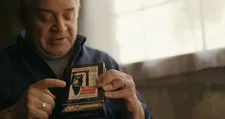 |
| Patton Oswalt in Chain Reactions Photo: Robert Murator, courtesy of Exurbia Films |
Philippe is one of those cinephilic filmmakers and while Texas Chain Saw Massacre remains at the heart of our conversation, we steer it towards broader ideas about spectatorship and meaning within cinema, as well as, respectfully, or hopefully so, taking some shots at cinema’s pomp and circumstance.
Paul Risker: One of the exciting things about you as a filmmaker is the question of what film you will choose next. So, how and why The Texas Chain Saw Massacre?
Alexandre O Philippe: I was at Athens airport a couple of years ago, and I got a call from Annick Mahnert, the director of programming at Fantastic Fest. She had just gotten a call from the folks at MPI at Dark sky, and she told me they wanted to talk to me about a project. It could not have been vaguer, and she asked whether she could put me in touch? I said, sure, because I'd take any recommendation from Annick. So, next thing you know, I was on Zoom talking to MPI, who handled the worldwide rights on behalf of the rights holders to Texas Chain Saw Massacre.
They were getting ready to celebrate the film's 50th anniversary, and they said, "We've seen some of your films, and we'd like to know if you'd be interested in making a film to commemorate the 50th anniversary?" It's one of those bucket list items, and it was an immediate yes. And the first thing that I told them was, "If we're going to do this, I would really like to explore the film through the lens of beauty and poetry, and the artistry of Tobe Hooper." But then, eventually, it really became a Rashomon-like structure about how the film got under the skin of five extraordinary artists. So, that's why I have this chapter-like structure and then, we were off to the races fairly quickly.
PR: The structure of Chain Reactions and the different ways each of the participants critique Texas Chain Saw Massacre emphasises the fact that while we are all watching the same movie, we're having our own unique experience.
AOP: That is the heart of what cinephilia is about. It's this idea that there is no definitive way to think about a film. And the great joy of being a cinephile, and I always say that I'm a cinephile first and a filmmaker second, is getting to have conversations with not just filmmakers, writers or artists, but other people about these films that you love, or hate is endlessly fascinating.
I'm curious and fascinated about how other people view a film that I hold dear, and so, I'm interested when I get the opportunity to talk to someone who hates a film that I love. And when I have the opportunity to talk to someone who loves a film that I hate, I think that I'll maybe hear something where I'll shift my thinking and be able to appreciate it in a way that I haven't before.
 |
| Alexandra Heller-Nicholas in Chain Reactions Photo: Robert Murator, courtesy of Exhibit A Films |
This exercise of being open to the ways in which other people think is something that, sadly, our society has lost right now, and it's something that we need to try and actively bring back. It's not just cinephilia, it's anything. We all view the world differently through a different lens, and so, making that effort to reach out and say, "Okay, I disagree with you, but I want to try and see how you view it" is a fundamental component of what it means to be human.
It's part of the storytelling process, right? It's an age-old ritual. We're telling stories to try to hopefully find connecting points, but also to understand ourselves better. That's what movies, books and stories do, and this is what we do with each other. That exchange is fundamental to who we are as humans, and we're lost now in our little phones, in our TikToks and all this bullshit, that we're forgetting about the importance of having those connections. We're going to bring that back, but we're in a downward spiral right now that is really scary — we need to start having those conversations.
PR: We should never take for granted the importance of talking about art and the sharing of ideas. As the old adage goes, for art to thrive, it must be discussed.
AOP: For sure, but I think that applies to every aspect of life. When someone tells me this is the way to interpret this film, and there's no other way, it's exactly the same as someone saying, "Excuse me, but I have to say it: Jesus saves, and if you don't go to Jesus, then you're doomed." It's like, well, I know you believe in Jesus, and that's wonderful, but there are other nuances; there are other beliefs. So, respecting other people's beliefs is fundamental as long as those beliefs don't encroach upon your personal life and safety. It should be that basic, but it's not.
The idea that there is a definitive way to think about or view a film is not because a director says what the film means to them. There are other ways to view it, and I don't think that the filmmakers themselves always have all the answers. In fact, David Lynch would never tell you what his film was about. And so, the joy of being a Lynch fan is that there's a million ways to interpret his films, and you learn from talking to other Lynch fans about the way they view things, and through that you make discoveries. And the really cool thing about this is that the more you talk about it and the more you discover, the more mysterious it becomes. It's not like you're getting closer to the truth; you're getting deeper into the mystery.
I've realised in recent years that's what I'm passionate about and that's what my body of work is about. It's exploring the mysteries and not providing answers, because that's boring.
PR: Listening to each of the participants presents Texas Chain Saw Massacre as a rabbit hole of cinematic parallels and unexpected themes and ideas. The one bit of clarity we're left with at the end of Chain Reactions is that we'll never see or think about Hooper's film the same way again.
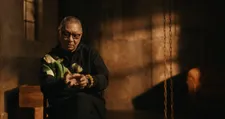 |
| Takashi Miike in Chain Reactions Photo: Robert Murator, courtesy of Exhibit A Films |
AOP: What's true of every great film or every great work of art, is that you have an artist or a set of artists tapping into something that is greater than they are. And so, of course, there is conscious craft, but they are putting conscious craft to the service of something greater, which is the zeitgeist and the collective unconscious. When you tap into the power of the collective unconscious, then you start tapping into myth. You start tapping into these ancient forces if you will, these ancient rituals of storytelling, which are going to resonate with people in different ways. And so, the more an artist is able to tap into that, then the deeper the text.
The amazing thing about that, though, is, historically, when you look back, for the most part, not always, the greatest films are on a first read very simple. Texas Chain Saw Massacre is Hansel and Gretel — it's very simple, but then you start peeling the layers, and then you realise it goes deeper and deeper. You can keep watching that film, and you'll keep finding something new. So, that's the genius of Tobe Hooper and Kim Henkel and all the extraordinary people who worked on it.
It's a very special film. When Takashi Miike says it's a film that we have to hold close to our hearts, and we have to take care of it, some people might chuckle at that, but no, wait a minute. Not only does he mean it, but he's right. This film is a treasure, and it continues to be so because it continues to speak about many important things that we need to process today.
Texas Chain Saw Massacre is 51 years old, and we're still talking about it. Are there many films that do that? I don't think so. Seriously, films that very recently received these top awards, we will never talk about again. 50 years from now I won't be alive, or I hope not, but we will still be talking about Texas Chain Saw Massacre because it's that powerful; it's that good.
PR: Patton’s observation about Nosferatu's optimism versus the cynicism of Texas Chain Saw Massacre's ending can be interpreted as an inherent negativity present in 1970s cinema. However, Texas Chain Saw's cynicism and despair resonates with our tumultuous present-day life. Whether or not Hooper intended it to be a political film, it remains a political and cultural beast.
AOP: What's remarkable about Texas Chain Saw is that you can absolutely make the argument that it's more contemporary today than it was 50 years ago, which is a crazy thing to say. It is a film about America tearing itself apart. When you talk about technology replacing people and driving them crazy, you look at what's happening with AI right now, and you could apply the AI lens to Texas Chain Saw. Look at what Patton talks about with the sun and the film being essentially a microcosm of an apocalyptic event. You could absolutely look at Texas Chain Saw as a film about climate change. So, yeah, you can go down the list.
That's what we're talking about, right? It's an extraordinarily simple story, but it's deceptively simple. It's about so many things and here we are 50 years later, and holy shit, it still resonates in significant ways about all the things we're going through as humans right now.
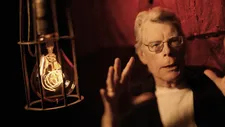 |
| Stephen King in Chain Reactions Photo: Robert Murator, courtesy of Exhibit A Films |
PR: Much of the experience of The Texas Chain Saw Massacre derives from the way Hooper used the film's sound design to get under his audience's skin. The marriage of image and sound is masterful.
AOP: Sound is extraordinarily important to Texas Chain Saw. It's interesting because I was thinking about this in relationship to my many conversations with William Friedkin back in the day when I was working on Leap of Faith. He talks about The Exorcist as being a sound museum, which is a very interesting way to think of it. But you can apply that same sentence to Texas Chain Saw, which is a sound museum. It's a remarkable achievement on every level of filmmaking and on every level of acting. The performance by Marilyn Burns, alone, how does that not get an Oscar nod? It's unbelievable.
There are these extraordinary moments in the acting. When she's tied up to the chair at dinner, and she's screaming at the top of her lungs, and she's exhausted, you feel her pain. And that moment in the gas station when she's being chased by Leatherface, you can see her body for a moment convulsing. Then, when she turns her head slowly to the barbecue and sees the human meat, she realises what's going on — you can see her wheels turning. How often do you find a performance like that in these Oscar movies? They are very rare, and so, to reference Spinal Tap, every level of the filmmaking is on 11.
PR: Films like The Texas Chain Saw Massacre don't require the anointment of awards because the way they've found a devoted audience through their emotional impact gives them a substance that no statuette offers.
AOP: Look, I got a nice Lion [award] at the Venice Film Festival, which was completely unexpected. But it shouldn't be the motivation, and I hate the culture of awards season. It's this idea that these filmmakers who have made a good or great film are going to go on tour and try to lobby for their film to hopefully get a bunch of statuettes. Literally they are going to put their lives on hold for that instead of doing what they're supposed to be doing, which is to make movies. I'm highly disturbed by that.
I understand the concept of it, but that's something we have to grow beyond as humans. The only thing that matters is the film, and when a film speaks to people, as you said, who cares about what it has won? What matters is that here we are, 51 years later, and we're still talking about Texas Chain Saw, and people are going to come and watch Chain Reactions and get to talk about the film some more. At the end of the day, that is what matters.
Chain Connections opened theatrically at Regal Union Square in New York and Laemmle NoHo in Los Angeles on September 19th, ahead of its national expansion on September 26th.