





Eye For Film >> Movies >> Milk Teeth (2025) Film Review


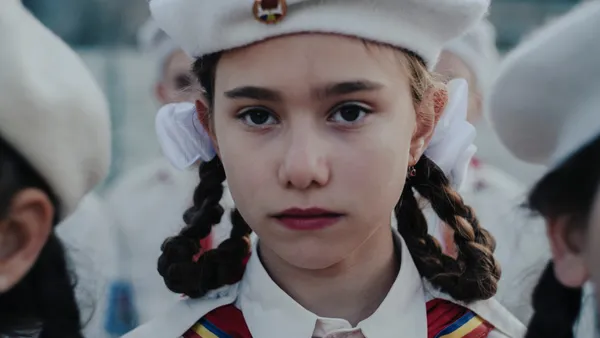

The handheld shooting style and child’s eye view of Minhai Mincan’s second feature may have a looser feel than his claustrophobic stowaway psychological thriller-cum-western, To The North, but his grip on tension and mood remains just as tight. Through the course of Milk Teeth, he doesn’t just get down to child height but also immerses us in his protagonist’s headspace and perspective, so that the melancholy mystery at its heart is examined in fragmentary and sometimes hallucinatory ways.
It’s April 1989 and the Romanian revolution is mere months away when we meet ten-year-old Maria (Emma Ioana Mogos) and her sister Alina (Lara Maria Alexandra Comanescu) who live with their parents (Marina Palii and Igor Babiac) on a bleak and brutalist estate, where they play with whatever they can find on the patch of green between the tower blocks. It’s a normal evening when Alina is left fizzing with anger after she is told to traipse to the communal bins with the walnut shells. “You’re a liar and a cow,” she yells at her sister as she carries the bucket past Maria and the other kids.

That will be the last interaction Maria has with her sister as she never returns from the chore. The little girl will carry the trauma with her for much of the rest of the movie, as she attempts to process what has happened in what amounts to isolation. At first, her parents are frantic, searching the canal and filing a police report with an officer (István Téglás), who comes to represent the general indifference of the Ceausescu regime. “Come back on Monday if she doesn’t show up,” he tells them.
As the days drift by into months – with the film moving to October 1989 and finally to the following March – we stay with Maria as she half grasps what is going on around her but where her own imagination also frequently holds sway as she tries to process the loss. This allows Mincan to mix the mood. Much of what unfolds is naturalistic and the writer/director elicits a finely worked performance from his young star. He shows how grief doesn’t stop joy intruding, such as a moment when we can see Maria’s anticipation of a treat from her mother light up her face. But Maria is also traumatised, her emotions taking shape in the darkness in nightmarish ways, the imagined just as real to her as her mother’s hand through her hair.
Mincan – who grew up in the period depicted himself – doesn’t need to make the politics or shifting social structures overt, they are just baked in. We don’t need to be told, for example, that the family of a little girl Maria visits must be somehow ‘connected’, we can see it from the ranks of dolls and hear it in the recording of Popcorn that she dances to as Maria experiences chocolate for the first time, turning it in her hand like an alien object before snapping it with her teeth. Nicholas Becker’s sound design in general may be less overt than the one he created for To The North but it is no less effective at conveying the emotions of a child. Milk Teeth thrums with the echoes of lost childhoods, not just those of the hundreds of kids like Alina, who never returned thanks to a system that didn’t want to scrutinise itself, but also those like Maria, whose stories have also remained untold. .
Reviewed on: 09 Nov 2025


