





Eye For Film >> Movies >> What The... Hen? (2025) Film Review


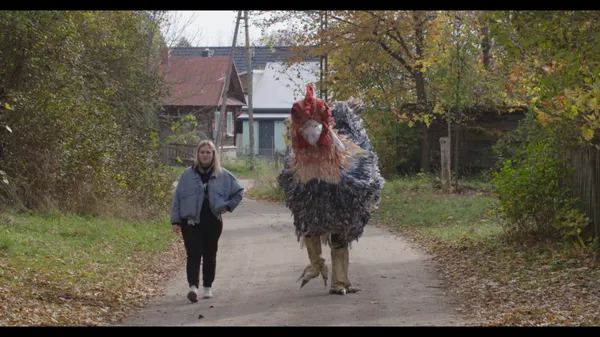

In the quiet, small Polish town of Solniki, the plans to build an industrial poultry farm have ruffled the local community's feathers. In the midst of this uproar stands Lukasz, a puppeteer, who dreams not of carving a wooden boy, but of building a two-meter-tall puppet of a hen – an enormous, handmade creature meant to march in protests and cluck for justice.
The debut feature-length documentary, by Joanna Deja, follows Lukasz’s winding journey to bring this hen, later named Marysia, to life. Shot over several years, it’s an intimate character portrait of artistic persistence. Lukasz is portrayed as the archetypal artist: slightly eccentric, obsessively detail-oriented, and disarmingly sincere. The rhythm of Solniki’s rural life, with its tractors rumbling past frozen fields and dogs barking at the giant puppet, becomes both a counterpoint and a cradle for his fragile creative world.

The cinematography is modest but precise. There are no sweeping drone shots or elaborate compositions, only a patient camera observing Lukasz’s daily rituals and capturing the melancholic beauty of the Polish countryside while the seasons slowly pass. Between these moments are vlog-like sequences shot by Lukasz himself, adding a touch of warmth and immediacy to the otherwise observational tone.
Filmed over several years, the biggest challenge lies in maintaining stylistic coherence across time. And yet, the transitions between years are so seamless that the passage of time nearly dissolves. The viewer occasionally loses track of how long this journey has stretched, but the sense of endurance remains palpable throughout.
Still, the world keeps fracturing. While the pandemic disrupts Europe’s cultural scene, Lukasz’s struggles intensify, and the economic hardship forces him to reconsider how an artist survives while the need for puppetry is put on hold. Then the war in Ukraine erupts, sending shockwaves even through Solniki’s sleepy fields. In an intimate conversation with a friend, as they discuss Lukasz’s peculiar profession and the effects of the war, a question arises – what can a puppeteer possibly do in times like these? His friend has an answer: “You distract them from fear.”
A small narrative shift comes when Lukasz opens his home to refugees. Among those who arrive is Sabina Bohynska, a Ukrainian woman who first appears in the background, then beside Lukasz in the workshop, and finally in the center of the frame. Sabina becomes his apprentice, assistant and collaborator. What began as a protest symbol against a poultry farm transforms into a shared act of healing and imagination in the face of destruction.
The film’s final chapter follows Lukasz and Sabina on tour across Europe’s puppet festivals, accompanied by Marysia and a pair of dog puppets. These scenes shimmer with wonder and childlike imagination. The artisanal creatures seem to breathe through their fragile movements, while echoing the long, painstaking process of their creation. The story has finally grown into something larger than a portrait of a single artist and becomes a reflection on how creativity survives crisis. How the act of giving form to something imagined can momentarily distract us from fear.
Reviewed on: 16 Oct 2025


