





Eye For Film >> Movies >> Veins (2025) Film Review


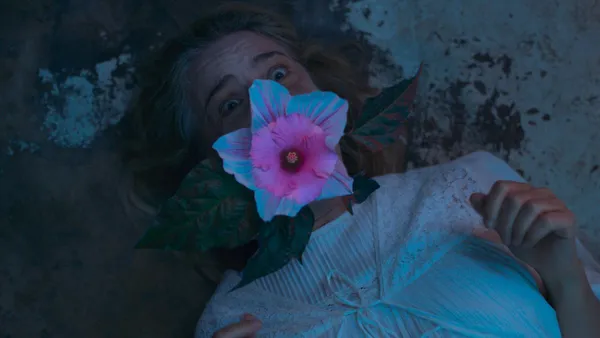

Veins Star Rating: 2.5 Quote: Directed by Raymond Saint-Jean Written by: Raymond Saint-Jean, Martin Girard Starring: Romane Denis, Marie-Thérèse Fortin, Sylvain Marcel, Richard Fréchette, Anana Rydvald Year: 2025 Runtime: 94 minutes Country: Canada Festivals: PÖFF 2024
On the one hand, we never leave this world; we are always here, just rearranged in a less orderly fashion, by the law of matter circling in nature. However, that does not mean that we can live forever, just like that. Or can we? What is the price of eternal life, since everything comes with one? Who knows, maybe the pain, maybe our consciousness… The Quebecois filmmaker Raymond Saint-Jean and his co-writer Martin Girard might have an idea, judging by their film Veins, fresh from the premiere at Black Nights Film Festival.
Isabelle (Romane Denis) and her girlfriend Catherine travel to Isabelle’s rural hometown to visit her parents for the weekend. However, Isabelle’s mother, Therese (Marie-Thérèse Fortin) has completely forgotten about the deal and she seems distraught in general. At the moment of their visit, her beloved garden looks unkempt, the family dog is nowhere to be found and her father is dead. Therese even forgot to inform her daughter about his sudden passing three days earlier. The mother also looks as though she is in physical pain, but she does her best to persuade her daughter that there is nothing wrong with her, as her new neighbour, retired doctor Toupin (Sylvain Marcel) takes good care of her and the rest of the remaining townsfolk.
Naturally, Isabelle senses that there is something off, and, as the seasoned horror watcher that we are, we should do as well. So, Saint-Jean takes us back in time, to some two months before, when the Isabelle’s father Maurice (Richard Fréchette) was still alive, and when the doctor, who had spent most of his career abroad came back to the town with his ailing Swedish wife Maria (Anana Rydvald) and with new, more naturalistic and wholesome take on life and nature. But, as Isabelle can see once the plot comes back to the present time, the “care” he takes could prove to be lethal.
There are a lot of traces of other filmmakers’ work in Saint-Jean’s body horror that is most reminiscent of an extended vintage monster-of-the-week-kind of episode of The X Files, with Isabelle as a more naive agent Dana Scully without agent Mulder to guide her through the esoteric. That might have been the plan from the get-go, as Saint-Jean and Girard effectively embrace the first rule of the modern horror that says: “no cell phones, no internet signal” by killing both of the perks of the current world with a couple of lines of dialogue. The plot keeps moving along the predictable lines, which gives Saint-Jean enough time to sprinkle the film with references to some refreshingly non-Cronenbergian body horror references – the most direct of them being the one to the alleged Japanese snuff movie Guinea Pig 2: Flower of Flesh and Blood (1985).
Saint-Jean and Girard obviously aims for something very edgy, but at the same time hippie-themed and with a measured message of the need to find the balance between nature and science. Their reliance on clichés is so obvious that it seems almost nonchalant, and the characters exist only in movie universes as such. The latter makes the actors’ work of imbuing them with any form of personality quite hard. Also, the final confrontation between our naive protagonist and the obvious villain, followed by a car chase coming out of the blue seems forced as hell, and so does all the rest of the efforts to tie the loose ends in the finale.
However, there are a couple of saving graces here. Firstly, the technical work in the special effects department is top-notch as the “installations” the team made appear quite palpable and astonishing and grizzly, which is always a plus in a body horror. The VFX are in tune with the detailed SFX and elevate them even more. Secondly, the striking visual Saint-Jean chooses for the final shot, just before the dynamic closing credits sequence, is quite powerful and bears quite a bit of symbolism and the message, but those kinds of visuals could have come a bit earlier to establish the film’s language outside of clichés and quotes.
In the end, Veins, as a genre film without the obvious “elevation” is a bit of a fish out of water on the festival circuit, while it is not a groundbreaking genre piece either. It is the type of film that an enthusiast would watch on a weekday night at a local movie theatre and the completist would catch on a streaming service or VOD.
Reviewed on: 18 Nov 2025