





Eye For Film >> Movies >> The Smashing Machine (2025) Film Review


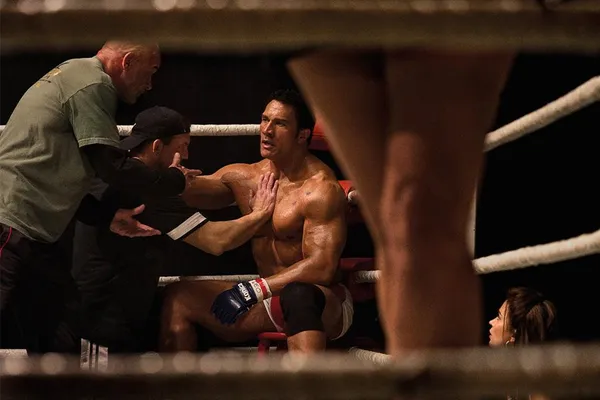

Having left his wrestling success behind him in favour of a highly lucrative second career as a family action hero favourite, there’s a neat circularity to Dwayne Johnson returning to the ring for a considerably more dramatic role. He’s certainly got the physique to play Mark Kerr, a former wrestler himself, who became a mixed martial arts and Ultimate Fighting Championship pioneer, and who Benny Safdie’s film captures in a key period from 1997 to 2000. Safdie draws heavily on John Hyams’ 2002 documentary The Smashing Machine: The Life And Times Of Extreme Fighter Mark Kerr – so it’s perhaps a little odd that the fact Kerr was being followed by a camera crew in this period is not specifically referenced.
Nevertheless this is a raw consideration of the crunching nature of the sport, which also follows Kerr’s opioid addiction journey and his equally bruising relationship with his girlfriend Dawn (Emily Blunt, whose ability to make us retain sympathy for her character despite repeated attempted smackdowns from Safdie’s script ought to put her in awards contention).
Safdie is known for bringing intensity to films with his brother Josh, with the likes of Good Time and Uncut Gems, and there’s plenty of that in the brutal fight scenes, which are shot in unfussy, sweaty proximity. By focusing a considerable amount of time on Kerr’s life outside the ring – though thankfully avoiding cliches regarding his addiction – there is a sense of the film falling a bit between two stools, not quite sports biopic, not quite character study, which may explain why it has performed rather disappointingly at the box office. Like it or loathe it, the cinemagoing public like to know which corner they’re in.
We meet Kerr when he’s on the up, having never lost a bout he’s in demand from the newly formed Pride event in Japan, which offers the prospect of more money than in the US. Outside of the ring, he’s a soft spoken soul – something Johnson sells well – who has a good relationship with the other fighters, especially long-time pal and sometime mentor Mark Coleman (Ryan Bader, who also proves to have decent acting chops). The situation with Dawn, however, is volatile, with his egocentricity locking horns with her neediness.
The meat of the film lies with them, so it’s a shame when she disappears from the scene for around 20 minutes, causing a slump in proceedings. Repetition also works against Safdie, with matches towards the end of the film feeling as though he is labouring the point. Late attempts to take us into Kerr’s headspace also feel like an unnecessary slide towards convention in a film that, more generally, treats its characters and themes with an everyday robustness. And just because you give a training montage the cinematic equivalent of the side-eye by using My Way on the soundtrack, does not mean it’s any less familiar than those employed in a more traditional way. There is a sort of competition going on in places, too, between dialogue and music in which both sides end up losing.
At its strongest when it considers loss and how you deal with it, the film also gains something from a sweet documentary epilogue that underlines what a nice guy Kerr is and suggests normal life might not be so bad after all.
Reviewed on: 12 Oct 2025


Director: Benny Safdie
Writer: Benny Safdie
Starring: Dwayne Johnson, Emily Blunt
Year: 2025
Runtime: 123 minutes
Country: US
Search database:
