





Eye For Film >> Movies >> Hungarian Wedding (2025) Film Review


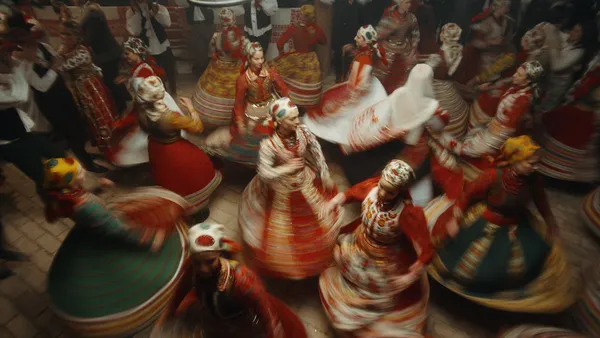

What marks out this, the 29th edition of Black Nights Film Festival in Tallinn, especially its competition selection, is the programming oriented towards repertoire and genre movies coming from the places less expected than, for instance, the USA, western Europe and East Asia. As a combination of a period piece adventurous comedy-drama and a folklore-inspired musical, Csaba Káel’s Hungarian Wedding serves as more of a confirmation of the “rule” than an exception to it. Still, this kind of cross-genre filmmaking is a rare occurrence in the main competition of relatively big festivals.
Budapest, mid-80s. Péter (Tamás Kovács) and András (Zsombor Kövesi) are best friends and mates in a punk-rock band who think that they only need better equipment to make it where it matters the most – in America. In order to raise funds for an original Stratocaster, they agree to a shady deal with a shady character – to smuggle some valuable icons from neighbouring Romania, on the pretence that they are going to and coming back from the wedding of András’ cousin Erzsi (Réka Bubik). So, equipped with the contraband from the West, especially cigarettes that served as the hardest currency east of the Iron Curtain back then, they set off on a journey.

When they reach the village in Transylvania where András’ extended family resides, they realise that they are not at a regular Hungarian wedding, but at a proper Transylvanian Hungarian wedding. That means a set of customs they know little about, a lot of local folk music, dancing “duels”, beer, wine and pálinka flowing in streams, if not rivers. To smuggle the icons out, they arrange a fake-dating deal between Péter and András’ other cousin, the more liberal-minded Kati (Franciska Törőcsik) who is actually engaged to the local power figure Gyuri (Barnabás Rohonyi), the son of the local policeman Pavel (István Znamenák) to save the honour of her blackmailed father. After the two actually fall hard for each other, complete and utter chaos ensues.
Regarding the chaos, one might expect stuff like friend- or sibling rivalry, city-mouse/country-mouse animosities and drunken fights to the sounds of strings-powered uptempo folk music. We are in the Balkans, or at least close enough to it, after all! But who would have thought of a proper car chase between a police Dacia 1300 and the even older Wartburg station wagon?! Nevertheless, it serves as the highlight of this Eastern European-flavoured piece of Americana where the scriptwriter and the director proudly wear their influences on their sleeves.
However, the thing to talk about here is the music composed by the contemporary composer Norbert Káel (possibly related to the filmmaker) and performed by István Pál and his folk band Szalonna. Unlike other movies, where the music and the dancing usually serve as a sort of illustrative, colourful background, here they dictate the rhythmic backbone of the film, which the editors Lili Makk and Viktória Kiss have to match with their cuts of Tamás Lajos’ kinetic and elaborate cinematography. It is a rare occasion that the music is used that way, especially the Romanian-Hungarian folk music, and that actually makes Hungarian Wedding stand apart from similar films that feature similar elements of genres, clichés and tropes.
That, however, opens a new set of problems and proposes a dilemma. Simply put, that much music and dancing in its authentic and integral form threatens to take over the film constantly and, in places, manages to do so. And the dilemma is whether Káel does it deliberately to cover the tracks of Miksa Békési’s script that keeps the characters roughly sketched, their actions neatly convenient for the steering of the plot, and the plot itself riddled with clichéd devices. It feels that, without the music interludes, or with them kept at the functional minimum, the film would have hard time reaching the feature-length mark, making it essentially a stretched short or mid-length. But given the extensive experience Csaba Káel has in directing operas and musicals on the stage, this kind of experiment is not at all out of character. It might not be entirely purposeful, but it suffices for a different, decent, crafty movie.
Reviewed on: 17 Nov 2025


