





Eye For Film >> Movies >> Hidden People (2025) Film Review


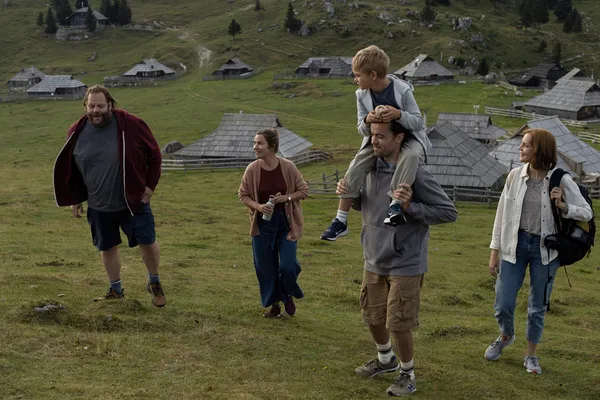

Slovenian filmmaker Miha Hočevar has made his name domestically with comedies and dramedies, either set in the milieu of kids and teens, or in the one of adults who refuse to grow up. The latter certainly goes for his 2000 breakthrough, Fuck It, that achieved a status of an instant cult favourite, despite obvious faults. After a coming-of-age immigration drama On The Sunny Side (2004) that had some international festival exposure, it seemed that Hočevar has found his commercially successful niche with comedies set in the milieu of boy scouts, a national mega-hit Going Our Way (2010) and its 2013 sequel. With Hidden People, the director is back to his roots, depicting a seemingly careless life of several slackers, but the question is if he has matured as a filmmaker, and, if so, how much.
The title comes from an Icelandic folk belief that there are far more people in our world roaming around than we can account for, but not all of them allow everyone to see them. The connection to the film’s content is pretty clear, one of the protagonists is an Icelandic amnesiac (Ólafur Darri Ólafsson, recently mostly active on television in Iceland and abroad) whose reason for being in Slovenia is a mystery, while the other one, Guti (Blaž Šef), prefers to live his life his own way, away from the prying eyes of the society.
The two of them wake up one morning on a riverbank handcuffed together. It is not much of the mystery how they ended up there – they got into a fight with a bunch of local Nazi-leaning thugs led by Janez (Gregor Gruden). The Icelandic giant was attacked because of being foreign, large enough in posture to become a trophy of sorts, and probably quite drunk, while Guti would not tolerate such an injustice, so he interfered. In the aftermath of it, they first have to unlock and set themselves free, then to determine the foreigner’s identity, since his documents have been stolen, in order to help him, while Guti has his own long-standing goal of building a raft to serve as his home, to great displeasure of his rigid and obnoxious first neighbour Bizjak (Igor Samobor).
Despite being a hippie, a wise-ass and a loudmouth, Guti’s fault in the eyes of his neighbour and his nemesis Janez (Gregor Gruden) is that, not just he wants to live his own way, which quite an “un-Slovenian” thing to do, but he also charmed Bizjak’s daughter and Janez’ ex-girlfriend Irena (Barbara Ribnikar). Bizjak’s other daughter Monika (Ana Urbanc) has, however, fallen in love with the gentle Icelandic giant who we later learn is called Sigi.
Eventually, can a group of outsiders helped only by Guti’s brother Bunny (Luka Marčetić, a filmmaker himself) and a community of like-minded outsiders and nature-loving idlers that live nearby survive the apathy, intolerance, threats and abuse from the society that uses greed, hatred and abuse of power as its fuel and as its tools?
There is a slight paradox with movies like this one, as they tend to defy the European dogma of dividing films between festival art house and repertoire flicks. The thing is, Hidden People is definitely not a festival-friendly film, as it seems too simple and easily comprehensive: we know what is good, what is bad and which of the characters represents what, the message is universal and clear to the point of banality, but humanity tends to miss it.
A film snob could even call movies like this a bit simple-minded and naive, which would be neither right nor fair. So, one could imagine films like this one faring well on the repertoire of local theatres all over the world, which could not be further from truth, as this one is not only predominantly in languages spoken by 2.5 million people combined, with some broken English as a glue between them, but also pretty much drenched in local “flavours” of menace. Even though every society has its share of Nazi thugs, cops bearing grudges, nosy and grumpy neighbours, fraudsters and the petit bourgeois silent majority, Hidden People is distinctively Slovenian in that regard, so foreign audiences can at best hope to catch it at some festival.
On another hand, one could imagine a global, English-language remake of Hidden People that could almost write itself, largely thanks to the universal and bulletproof story by the late Serbian writer Srđan Koljević and Hočevar’s effort to colour it with local “aromas”, along with a bunch of local ones. In the English-language version, it could serve perfectly well as an unpretentious, feel-good, but still quite ethically firm indie.
The Slovenian version, however, works because of the filmmaker’s willingness to let his actors act and interact seemingly freely, but with the awareness of the characters they play. In that domain, the physical contrast between the two leads works as a somewhat blunt, but still effective comedic tool, especially when matched by the two guys’ equally opposing demeanors. Simply put, both of them are good fits for their characters, Ólafsson as a man of few words with deadpan delivery, and Šef with the way he plays the eagerness and quick reactions of his character. Along with Marčetić, who previously wrote and directed comedy, so he knows how to play it, and Samobor (glimpsed in a 2013 Lux Prize nominee Class Enemy as a rigid professor) who is a go-to choice for those “hardass” types, the chemistry is simply crackling.
Hidden People is by no means a masterpiece. It might seem overly simplified and almost generic in passing the message that everything would be easier if the people were nicer and more sincere to each other. And it is certainly a film based on a blueprint of sorts. But that blueprint is executed elegantly, unpretentiously and with a certain sincerity and auteur integrity.
Reviewed on: 28 Aug 2026


