





Eye For Film >> Movies >> Franz (2025) Film Review



The word “Kafkaesque” is bandied about a lot in reference to nightmarish situations and labyrinthine bureaucracy but it’s worth remembering that the Czech author of works including Metamorphosis and The Trial also majored in darkly comic absurdity. This latter trait is something Agnieszka Holland seizes upon for her playful biopic that rips up chronology and frequently tears down the fourth wall so that we’re never sure if we’re going to be the ones looking into the fishbowl of his life or the ones being inspected.
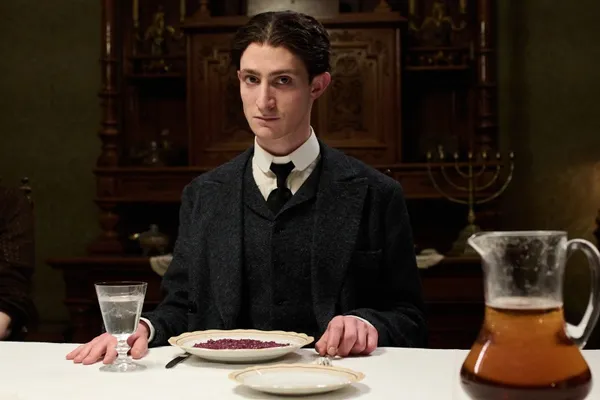
While it may not be exactly nightmarish – though a sequence dramatising his barbaric ‘harrow’ in The Penal Colony is not for the faint-hearted – Tomasz Naumiuk’s camera angles and movement, along with Pavel Hrdlicka’s editing, and knowing sound design immerse us in the headspace of Franz (Idan Weiss, whose carefully calibrated and awkwardly charming performance goes well beyond the fact that he is also a physical ringer for the author). Holland’s choices also lend this drama an almost constant mood of anxiousness, which her script (co-written with Marek Epstein) suggests was a sensation Franz was all too familiar with.
“A little bit of fear will be a good lesson for him,” Franz’s overbearing dad Hermann (Peter Kurth) says as he bundles his young son out on the doorstep at night – later he ditches him, without water wings, in a lake. These formative experiences, which also show Franz had a warm relationship with his sisters, are unveiled in snippets interwoven them with later moments in his life and, most bracingly, with the modern-day perspective of him offered by tourist guides and tat shops. Sometimes characters also break off from the business of being in a film to directly address the camera and offer their opinions on him too. While this may sound like a scattergun approach, Holland – whose film premiered in Toronto and will make its European bow in competition in San Sebastian – is adept at joining the dots, so we can see the connective tissue spanning his life and the money-making wheels that have been in motion since.
“They stole my silence,” Franz laments in one scene and as we watch him spend time with his family, it’s easy to see why he craves it. Bookish and introverted and, despite his best efforts to join the war, trapped in insurance work, Holland was able to draw on the wealth of letters and papers his friend Max Brod (Sebastian Schwarz) preserved after Franz’s death despite the author asking that he burn them. Her approach allows Franz’s sensitive side to shine out in his relationships with women, even if they were frequently unsuccessful. A tender encounter in a brothel, while his pal goes at it hammer and tongs on the other side of a curtain is a perfect example of how Holland finds both humour and poignancy through juxtaposition.
A prolific letter writer – emphasised by one tour which shows missives spewing out of a wall – Holland’s focus falls particularly on Franz’s relationship with Carol Bauer (Carol Schuler), which worked better on an epistolary level than in the flesh, as well as liaisons with Greta Bloch (Gesa Schermuly) and Milena Jesenska (Jenovefa Bokova). Holland offers a supple history that bends and flexes to incorporate not just Franz’s perspective but those others have thrust upon him, while allowing him to take a good look at our treatment of his legacy.
Reviewed on: 15 Sep 2025


