





Eye For Film >> Movies >> Flophouse America (2025) Film Review


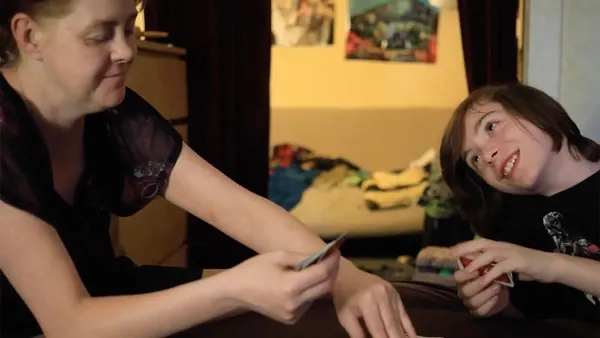

The numbers presented at the beginning of Monica Strømdahl’s fly-on-the-wall documentary are stark. Official US statistics show about 34 million people living in poverty, many of whom live in long-term hotels or motels due to lack of affordable housing. Meanwhile, one in ten children there lives with at least one parent who has an alcohol abuse disorder. Not all of these things might be happening simultaneously to a child, of course, but in the case of 12-year-old Mikal, they are.
Strømdahl was deep into a photographic project with the same title as this film when she met the youngster when he was 11 in the lobby of the hotel where he had been raised by his mother and father Tonya and Jason. For the next three years she took a raw and unsanitised look at their lives in the cramped and cluttered room that they all share with their cat Smokey, who deserves some sort of animal sainthood. The trust the family put in Strømdahl – who was her own cinematographer – is evident in the way that life goes on around her uninhibited. It’s also worth noting that consent was uppermost in the filmmaker’s mind and that she waited until Mikal was 18 and could properly sign off on it before the film was released.

While there is plenty of love in this cheek-by-jowl household, it is matched by problems, most notably Tonya’s alcoholism, with shots of vodka robbing her of sense on a daily basis and infusing her with anger that leads to repeated verbal confrontations with her son. Jason is working but also has drinking issues that lead him into slanging matches with his wife.
Strømdahl keeps us within the apartment for virtually the whole film, watching as Mikal tries to negotiate the unpredictability of Tonya and Jason or retreats into a world of video games. The tragedy of alcohol is fully illustrated as the documentarian’s observant gaze often catches moments of tenderness between mother and son that become marred by drink and frequently need to be refereed by Jason.
The proximity also brings home the unsuitability of this environment for a family. Mikal’s only privacy is behind a scrappy curtain, while the bath is shown to be a semi-permanent home for the family’s dirty crockery. While there’s never a sense of the family playing to the camera, once or twice you sense Mikal is taking a small amount of comfort from knowing it is ‘bearing witness’ to this one-room maelstrom that is out of his control. His voice is also heard in occasional poems, all of which focus on emotions that he might otherwise not be able to express.
The ongoing chronic tragedy of the household will ultimately be split by an acute one. Strømdahl, while remaining clear-sighted about this, handles it with care in ways that don’t exaggerate or worsen the family’s pain. A raw and uncompromising portrait that makes us look directly at a situation that would normally remain behind closed doors.
Reviewed on: 17 Nov 2025


Search database:
