





Eye For Film >> Movies >> Fiume O Morte! (2025) Film Review

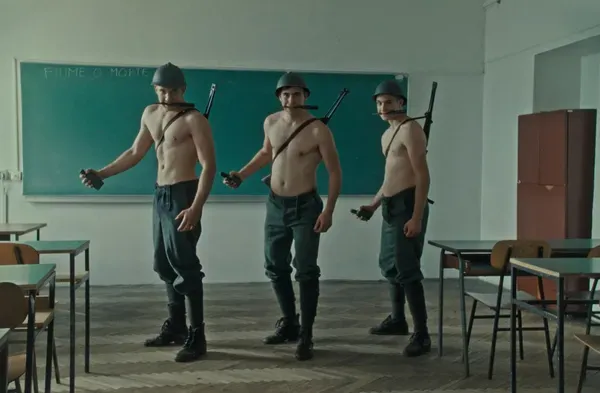

The year is 1919. Italian poet, army officer, cocaine addict and Mussolini’s penpal Gabriele D’Annunzio, armed with what seems to be the Napoleon complex, is convinced he can proclaim Fiume (today Croatia’s Rijeka) his own state. The year is 2025. Igor Bezinović, Rijeka-born director and screenwriter, releases a documentary on the city’s occupation, slightly less self-aware than D’Annunzio – a fact that does nothing to prevent the film from winning the Best European Documentary at the European Film Academy awards.
Bezinović puts us in D’Annunzio’s red Fiat and takes us for a ride through the 16 months of Rijeka’s occupation – a chapter in this port-city’s history which took the director a decade to research. Set against the Rijeka’s largely oblivious youth, several older passers-by Bezinović interviews not only remember this historical spectacle, but are quick to note that such “horrible fascists” are “still around today”, revealing the documentary’s underlying sense of urgency.
Instead of criticising his own townspeople for their lack of historical knowledge, the director uses it to reconstruct D’Annunzio’s Fiume of 1919, casting locals – and locals only. While some are cast for their familiarity with the Fiuman dialect, the others are chosen for their ability to somersault into the water, and, most tellingly, some are employed simply for their baldness, echoing D’Annunzio’s physical traits. Not one, not two, but seven men are chosen for the role – a decision that both fractures D’Annunzio’s authority and underscores the unreliability of history when told through multiple sources and competing narrators.
Although rigorously factually precise, Bezinović does not shy away from stepping into the role of narrator himself, grounding the story of his hometown in a narrative intimacy that reflects on what is there now and what once stood in its place. Though cast for a specific role, the bald heads also function as talking heads, as Bezinović allows his performers not only to fill visual gaps, but to voice opinions of their own. In doing so, Fiume o morte! makes visible both the process by which history was created, as well as a way in which it was re-created. Blending together re-enactment and testimony with Rijeka’s historical legacy and archive, the film opens up the possibility of manipulating not only time but genre itself.
Incredibly rich in archival material – much of it drawn from D’Annunzio’s own photographic collection of some 10,000 images – Fiume O Morte! resists a purely historical reading, instead inviting a present-day sociological perspective in which the authoritarian leader becomes one element within the city’s layered history. Little remains of Rijeka’s fascist history in physical form, and what does is as thoroughly recontextualised as possible: a staircase built in 1920, once discovered by a local resident, now serves simply as his private garden path. Bezinović’s excavation and screening of an almost forgotten past is a triumph on its own, however insisting on reconstructing events which deliberately lack visual proof – such as D’Annunzio’s troops disrupting the Italy-sought referendum – is cinema’s own powerful victory. Numerous further interventions disrupt the historical narrative and point to cinema in the making, from manipulation of archival footage by slowing it down where, ideally, it should have been stopped, or widening and narrowing the frame.
Fiume O Morte! lays bare the romantic seaside city’s far less romantic fascist past with the same directness it applies to exposing its own process of filmmaking: backgrounds come down, locals intervene, are left in, and, most memorably, one of the seven D’Annunzios steps out of his car to join a band – Iz@ Medošević & Borgie. This temporal crumbling functions both as an intended commentary and as an inevitable source of humour, as when a Wolt delivery driver casually bikes past a convoy of D’Annunzio’s trucks entering Fiume. Rather than treating time as a divide between present and past, Bezinović’s time is closer to present perfect tense where historical events persist, overlap, and remain relevant in the present. It is no coincidence, then, that a film about a city where D’Annunzio once banned the carnival should end in a carnival itself.
Before we join the singing, what prevents us from leaving the cinema mindlessly humming Giovinezza, wearing the satisfied smile that often follows an impeccably made and genuinely funny film, is the context of our laughter. Humour directed at historical events requires a distance that only time can provide. Yet in a world once again populated by authoritarian figures – who are not even poets – nothing feels safely comic, and there is no such thing as a political past.
Reviewed on: 03 Feb 2026


