





Eye For Film >> Movies >> Calle Málaga (2025) Film Review


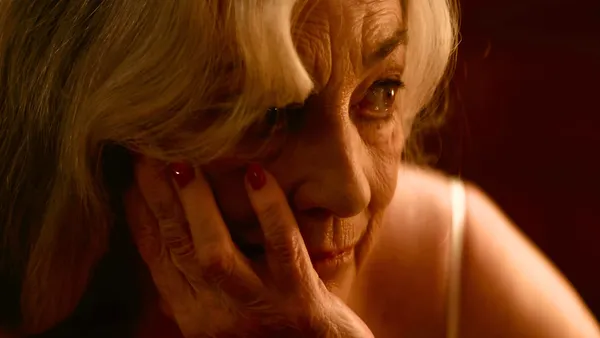

Maria Angeles (Carmen Moura) has lived in the Spanish quarter of Morocco’s Tangier all of her life, raising her daughter Clara (Marta Etura) there, who has since left for Spain where she is raising her own family. Writer/director Maryam Touzani and her regular cinematographer partner Virginie Surdej have always shown a knack for immersing us in an environment, from baking in their first feature together, Adam, or tailoring in The Blue Caftan. In Calle Málaga it is via a trip to a market that they show Maria Angeles fits her city like hand in glove, creating such a welcoming atmosphere that will make you want to walk into her world and settle in. The film premiered in the Spotlight section of Venice and will be a Special Presentation in Toronto – although it could easily have competed in the main section of both. It also screens at London Film Festival.
Surdej has always been adept at capturing light but Moura’s thoughtful performance makes it seem as though her character is glowing from within as she visits various stalls in an immaculate outfit topped off with a mint green cardigan and wheeling a trusty shopping trolley. Back home, as she cooks food in anticipation of a rare visit from Clara, the croquettes shine so invitingly in the egg wash that you’ll be tempted to reach out and touch them. There’s a sense of flow not just in Moura’s performance but in the craft more generally – from the flowers on Maria Angeles balcony that are mirrored in her outfits to the repeated use of her favourite record, Maria Dolores Pradera’s yearning Toda Una Vida, to add to the mood.
The atmosphere shifts sharply with Clara’s arrival as she announces out of the blue that, because of money worries stemming from her divorce, she is about to sell her mother’s home, which her dead father put in her name, out from under her. She presents her mother with two equally unpalatable options – to uproot herself to Spain or to take up the offer of a free spot in a retirement home in Tangier. We are as affronted as Maria Angeles, having already spent enough time in her company to know she’s an independent soul who is managing just fine.
Where some filmmakers would use this schism for melodramatics, Touzani and her husband and co-writer Nabil Ayouch, instead show how Maria Angeles largely greets the news with a steely silence, although she shares her frustrations with her old friend, nun Sister Josépha (a wonderfully pitched physical performance from María Alfonsa Rosso), whose vow of silence doesn’t impede her enjoyment of juicy gossip. It’s not anger but hurt that is the dominant note of a film that, while not demonising Clara, hinges on a lack of empathy for the older generation, where a jettisoned gift is the cruellest cut of all.
With her possessions – including her beloved antique record player – sold to local dealer Abslam (Ahmed Boulane) or given to neighbours in an exchange brimming with a brittle jollity that overlays her sadness, Maria Angeles is ensconced in the home, which we all know can’t last. Moura puts in the work and Touzani gives her room for manoeuvre. There’s no need for elaborate scripting when Moura’s body language immediately conveys just how fed up she is. Soon she is hatching a plot to return to her home – at least until it is sold – and buying back her furniture from Absalam one piece at a time.
What could have been played for tragedy, although not without poignancy, is largely shown to be a triumph as Maria Angeles finds some ingenious ways to keep herself afloat, while also finding herself increasingly drawn to Abslam as the antique dealer realises he may have met his match in more ways than one.
Like Maryam Moghadam and Behtash Sanaeeha’s My Favourite Cake, this is a crowdpleaser that is built on the strengths of the central character right from the start, as, despite opposition, Maria Angeles gradually gains the upper hand. This isn’t a fuzzy celebration of making do with what you have as you get older but of embracing the passions that endure, with Touzani not suggesting that it is us rather than Maria Angeles who need to pay attention to the pleasures of her life. Often stories about ageing women are about journeys of rediscovery but the wonderful thing about Maria Angeles is that she was never lost.
Reviewed on: 03 Sep 2025


