 |
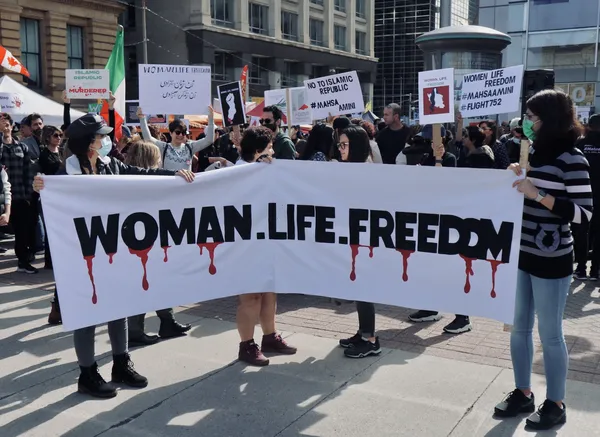
| Protestors in Ottawa urge Iran to take action on women's rights Photo: Taymaz Valley |
In an ongoing effort to clamp down on public protests against the mandatory covering of women's hair, the Iranian courts have passed sentence on actresses Azadeh Samadi, Leila Bolukat and Afsaneh Bayegan, prompting an international outcry.
Last Friday, film and theatre actress Samadi, who has long been politically outspoken, was described by the court as having an anti-social disease and told that she would receive two months in prison unless she agreed to undertake psychiatric therapy until she is deemed to be cured. On Wednesday, Bolukat, a well established film actress who has recently gained fame for her small screen work, was banned from acting for two years. On Thursday, Bayegan, some of whose films have enjoyed international success, was given a two year suspended prison sentence, banned from travelling for the duration and ordered to undertake regular therapy for 'anti-family personality disorder'.
Human rights groups have documented numerous cases of rape and other sexual violence in women's prisons in Iran, so the threat of even a short time behind bars is a very serious one. All three woman have been banned from using social media, making it difficult for them to speak out about what has happened to them.
Bayegan, who was a high profile beauty queen before the revolution of 1979, was arrested after sharing photographs of herself wearing a hat rather than a hijab. Bolukat had only shared pictures of herself without a hijab on her personal accounts, but was convicted of damaging public morality. There are reports of the government having put pressure on production companies not to hire actresses who reject the mandatory state dress code.
The Directors Guild of Iran and Iran Producers Guild have both condemned the court rulings, which follow a series of severe and increasingly arbitrary sentences against ordinary members of the public for refusing to comply with the law. The outbreak of resistance was sparked by the death of Mahsa Amini in the custody of the morality police last September.
Human rights organisations and groups supporting artistic freedom around the world have also spoken out. Julie Trebault of PEN America called the sentences a "calculated assault on artistic freedom and women cultural rights defenders...gravely encroaching upon the freedom of visual artists, actors, and filmmakers alike."