





Eye For Film >> Movies >> Born On The Fourth Of July (1989) Film Review


The Sixties were love, peace and marching to Washington. They were also Kent State, Watts and Mayor Daley's Chicago. The permissive society opened the hearts and minds of a generation indoctrinated by John Wayne, Kennedy rhetoric and the star spangled banner.
Racial strife was on the streets. Reactionary backlash brought out the National Guard. The CIA - or was it the FBI? - lobbed heroin into Haight Ashbury and poisoned the roots of flower power. Kids burnt draft cards, played the Joan Baez songbook and smoked homegrown grass.

Ron Kovic was different. He loved his country. He wanted to serve. Even at high school, he was saying, "Communism must be stopped." His dad ran the supermarket in Massapequa, a small town in New York State. They were good Catholics.
This is not the story of Kovic's fall from innocence in a dirty war, or rise to manhood in Vietnam, before being blown to bits by a mortar shell. It is the story of truth against untruth, deeds against dogma, how the agony of south-east Asia exposed patrotism as propaganda and American pie as a rock'n'roll nightmare.
Lies don't hurt; lies are easy. When he comes out of hospital, chairbound and tubed, Kovic is an embarrassment. Where is that handsome jock, who played sports like a prince, gave 101 per cent and was accepted by the Marines? Not this drunk, howling "I wanna be a man again!", weeping like a girl, asking, "Who's gonna love me?"
In the Bronx veterans' hospital, where the filth and humiliation was a fact of life and spaced out attendants shot up in closets, the reality of paralysis slammed hope shut. Later, in Mexico, among paraplegic outlaws and disabled defectors, he discovers that whores can be paid to pretend.
Sadness has nothing to do with it. "There is no God," he screams at his mother. "He's as dead as my legs." In a society obsessed with success and male sexual fantasy, he's a ghost.
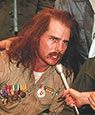
Kovic is a winner who learns to lose. The process is painful. Tom Cruise captures the essence of his fighting spirit perfectly, containing, even when ragged and raging at the Republican Convention, a crippled hippie holding a flag, the memory of that keen kid from Massapequa, who saw the world as a brave and beautiful place.
The film is too long and lapses occasionally into soft core romanticism, blunting Cruise's edge. However, the script by Kovic and director Oliver Stone has a gangrenous reality to it and there are sequences of blistering brilliance, especially at the hospital and with Willem Dafoe in Mexico.
As an epitaph to courage, it is memorable.
Reviewed on: 12 Oct 2003


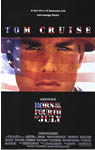

Director: Oliver Stone
Writer: Ron Kovic, Oliver Stone, based on the book by Ron Kovic
Starring: Tom Cruise, Kyra Sedgwick, Raymond J Barry, Willem Dafoe, Jerry Levine, Frank Whaley, Caroline Kava
Year: 1989
Runtime: 144 minutes
BBFC: 
Country: US
Festivals:
Search database:
