





Eye For Film >> Movies >> The Man In The Iron Mask (1998) Film Review


Ever since The Three Musketeers and its second sitting, The Four Musketeers, swashbuckling movies have become romps. Bertrand Tavernier's infinitely superior D'Artagnan's Daughter (1994) introduced the idea of the All-For-Oners being clapped out old wrinklies. The humour, in that case, was ageist. Randall Wallace borrows from Tavernier, leaving style and wit out of it.
The great Depardieu (Porthos) is reduced to waddling naked into a barn to hang himself because he cannot rise to the occasion with three buxom wenches. Aramis (Jeremy Irons) is a man of God, serious and politically active, while Athos (John Malkovich) mooches around the house, enraged by the King's treatment of his son (a David and Bathsheba situ). D'Artagnon (Gabriel Byrne) is a shadow of his wild youth, loyally serving the cruel Louis as palace security chief.
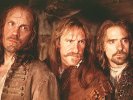
Although accomplished at sword throwing, he stays out of trouble and alienates himself with the AFOs - he's no fun anymore. The queen mom (Anne Parillaud) is seen giving him a look, implying that she's not averse to royal rumpy when circumstances allow. Also, D'Art has a regular order at Interflora, a single red one being his particular weakness. "I know that to love you is a treason against France," he coos. "It is not a treason against my heart." Er... sick bag, Maam?
The story of Louis' twin brother, Philippe, kept in solitary at the Bastille for years and forced to wear iron headgear so that no one can recognise him, is a classic adventure yarn. In fact, Philippe would have been off his rocker by the time The Musks spring him. Instead, he's incredibly nice. After intensive etiquette training out in the country, the plan is to swop P for L at, of all things, a masked ball.
Wallace wrote the script for Braveheart, which means he has a cavalier approach to history. As a rookie director, he lacks visual flair and tends to hug clichés for safety's sake. He follows Milos Foreman's example in Amadeus and disregards accent clashing.
The Musks speak English, American, mid-Atlantic and whatever comes out of Gerard's mouth. Having the King of France talk Californian and his mother a thick Frenchified brogue is faintly ludicrous.
Leonardo DiCaprio (Louis/Philippe) appears uncomfortable in his costumes and cannot emulate nursery-ingested arrogance, as one born to the velvet. He strikes poses that are not entirely convincing, happier as the shy, uncertain Philippe.
Irons is surprisingly agile, entering into the charade with enthusiasm. Malkovich, also, is trying, his trademark intensity bringing some weight to Wallace's wafer words. Depardieu embarrasses.
Here is Europe's finest film actor made to look superfluous. Alexandre Dumas won't be turning in his grave. Star studies, after all, are a form of flattery and a poor imitation is quickly forgotten.
Reviewed on: 19 Jan 2001


Director: Randall Wallace
Writer: Randall Wallace, based on the novel by Alexandre Dumas
Starring: Leonardo DiCaprio, Jeremy Irons, John Malkovich, Gerard Depardieu, Gabriel Byrne, Anne Parillaud, Judith Godreche, Edward Atterton, Peter Sarsgaard, Hugh Laurie, David Lowe, Brigitte Boucher
Year: 1998
Runtime: 132 minutes
BBFC: 
Country: US
Festivals:
Search database:
