





Eye For Film >> Movies >> The Choral (2025) Film Review


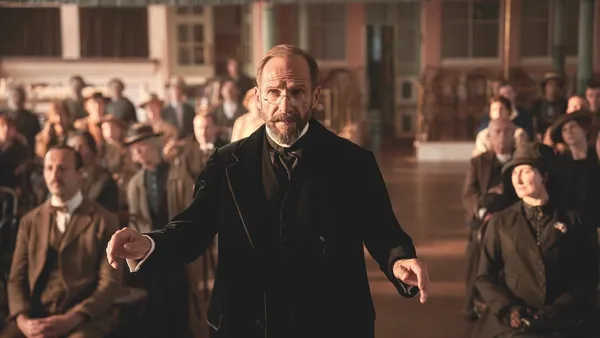

Director Nicholas Hytner and writer Alan Bennett’s First World War drama opens with the misleading sounds of gunfire. We imagine we’re to be transported to the killing fields of France, the trenches and the ghastly No Man’s Land. Instead, we’re in the midst of a Yorkshire pheasant hunt.
The war is always something far off, at least geographically, in this gentle dramatic comedy about a choral society in the fictitious town of Ramsden. With their ranks depleted due to men joining up, its administrators, Alderman Bernard Duxbury (Roger Allam), Mr Trickett (Alun Armstrong) and Mr Fyton (Mark Addy), have changed the rules to allow anyone willing to give singing a try to audition.
When, in the run-up to a performance of St Matthew’s Passion, their choir master decides it’s his patriotic duty to volunteer, Duxbury and Trickett are forced to accept Fyton’s controversial suggestion of the gifted Dr Henry Guthrie (Ralph Fiennes), who has been living and working in Germany, as a replacement.
Then, there’s the controversy over the choral society's choice to perform a piece by the German composer, Bach. Running through a list of other possibilities, including Beethoven, who was German, and Handel, who was German-born and later lived in Britain, Guthrie suggests Edward Elgar’s new piece, The Dream of Gerontius.
Filled with an ensemble cast of familiar British faces, including Simon Russell Beale as Elgar, the onscreen chemistry crackles. The cast convey the weightiness of the war, which works its way into every crevice of rural Yorkshire life, with humour and at times the self-knowing silliness of Bennett’s screenplay.
Bennett’s strength is knowing how to direct the focus of the story, particularly the significance of those scenes that will shape it in the memories of the audience. What the audience remembers is not the film as a whole but moments that create the illusion of the complete story. And it’s not only about the story but allowing the audience to see or feel the emotional soul of the film.
The Choral finds its humanity in an abundance of touching exchanges. In one scene, Mitch (Shaun Thomas), a young lad, due to go out to France, strips naked before Mary (Amara Okereke), a Salvation Army nurse and choir singer he has been courting. Shocked, Mary covers her eyes. Mitch asks her to look at him because he wants her to see him as he is now. In another scene, Clyde (Jacob Dudman), a soldier who has returned from war with his one arm amputated, asks his former girlfriend Bella (Emily Fairn) to give him a helping hand, a hand-job, until he’s built up the strength in his remaining arm. These are scenes played with humour but touch the characters’ humanity.
Hytner and Bennett uncover small details in these unexpected moments that illuminate the horror of war, the quiet fear it provokes and how it ravages the human body. Nor is the sense of pointlessness of the war lost on us, a point succinctly and poetically punctuated when Guthrie quotes the German writer Johann Wolfgang von Goethe: “A man should hear a little music every day of his life, so worldly cares may not obliterate the beautiful in the human soul.”
The Choral is an appeal to man’s kinder and gentler nature, at a time when French soil was soaking up the blood of mass carnage. It’s a film that quietly pleases and the fact that it elicits a muted response complements its gentle nature.
The power of The Choral is that it evokes smiles and laughter in opposition to the oppressive reality of these war years. Even the characters seem to find reason to smile and laugh, but there’s an inescapable fate awaiting those who refuse to be conscientious objectors. While The Choral is a tender film, Hytner and Bennett find moments to make scathing statements, about the sickening and cavalier way in which young men were fed to the war machine.
From the priest on the platform to see the boys off, shouting after them, “Home by Christmas!" to the absence of the priest for the returning wounded. Or the woman on the panel of the tribunal for Guthrie’s pianist, Robert Horner (Robert Emms), a conscientious objector, who condemns him for not doing his bit. She talks of being a crack shot and her regret at not being able to fight because she’s a woman. Alongside her, a priest who is content to argue that war is part of God’s plan, just read the Old Testament, he says, savagely condemns the young objector. And yet, in keeping with the film’s gentle spirit, Hytner and Bennett slip in subtler statements, including a little controversy about a Battenberg cake.
There are junctures when you want to scream at the screen, to try to shake people into realising what is happening. But what would be the point? We are looking back with hindsight, and we’re still reckoning with the reality of what happened. What’s out of anyone’s control is that if these characters should make it back home, they’ll be changed by what they've experienced, and the young will have unnecessarily lost some of their innocent years.
Aside from the themes and ideas that emerge out of these politicised statements, The Choral is a simple story about how art is a sanctuary from the darkness of life.
The Choral played in the Gala section of the 69th BFI London Film Festival. It is in UK cinemas now and will be released theatrically in the US on 25 December.
Reviewed on: 11 Nov 2025


