





Eye For Film >> Movies >> Pickup On South Street (1953) Film Review


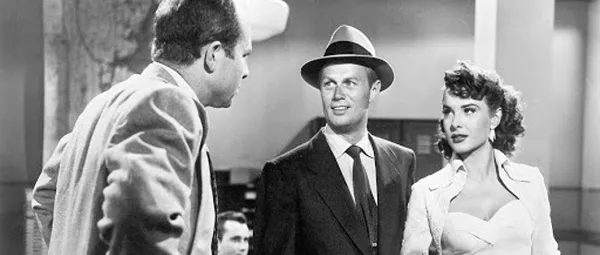

Effortless style is a something that is highly prized in film, and thankfully many films get the proverbial smoke in the bottle rather easily. It is quite different when the film is classy without really trying. Samuel Fuller's Pickup on South Street is one such noir. Let me illustrate.
The chief of police, Captain Dan Tiger, is talking with a government agent about petty crook Skip McCoy, a three-time convict and pickpocket who has picked the wrong purse.

Agent : "I'm looking for a pickpocket."
Tiger : "What's his name?"
Agent : "Don't know"
Tiger (almost immediately, while lighting a cigarette): "We're in trouble."
*a short beat*
Tiger : "You know what he looks like?"
Agent : "Mm-hmm"
*another short beat with a blast of cigarette smoke*
Tiger : "We're in business"
He then, without turning his body or head, flicks open the filing cabinet, and without really looking in, grabs a handful of mugshots.
It is the hard-boiled simplistic delivery and effortless half-grace that I love so much about film noir. There are other ingredients, but it's the direct and straightforward writing and performing that I enjoy most.
The purse that McCoy picked contains the quintessential McGuffin, government secrets on microfilm, and the courier, the potential femme fatale, is unknowingly working for the Communists. They're represented in the film as characters who say little and drive some inhuman gravitas around the chief villain of the piece. I enjoy the use of the Communist regime as the means for driving some kind of faceless, thick evil into the film, a manipulative message from capitalism which resonated strongly with most of the 1953 audience.
Why do I enjoy it so? Simply because it's such an obvious and fun play by the filmmakers to drive a chill down the spine of its intended audience. It doesn't work so well nowadays, what with the current American political climate and media-savvy viewers, but it's not difficult for a modern audience to get the point. The microfilm is hidden in a pleasingly primitive icebox of beer, substituted and replaced with a copy of the January 5, 1947 edition of the New York Times thanks to the New York Public Library. (If any reader cares to explain the significance of this, feel free.)
Both sides are helped and hindered by another fruity and delightful character, Moe, played by Rear Window's Thelma Ritter. A professional and wily stool-pigeon who sells cheap ties as her cover, she interrogates the government agent in the methods and techniques of pickpockets, and argues her price. "The price of living has gone up 50 per cent," she complains bitterly. She also gets her moment of dramatic weight, as the EvilBastardCommies try to recover the stolen film. The courier attempts to get the microfilm back off McCoy, and they end up falling in love, although several plotpoints keep them off each other's bones.
One area in which the film is innovative is the editing, creating tension in the scenes of pickpocketing. Fuller directs as though McCoy was painting a work of art, so slowly, and lovingly, his camera captures the action. Another masterful set of edits using faces happens when the agents are tailing the courier. The close-up tailing and chase editing techniques were reused to similar effect in Scorsese's recent The Departed. Another episode like this occurs when the villain meets with the EvilBastardCommies and through this a scene of impending, palpable doom plays out through eyes and faces half-bathed in shadow.
As a piece of noir, Pickup on South Street is successful. Three lightweight criminals without a drop of real heroics, dark shadowy photography where there isn't a drop of real white in the film stock, only shades of gray, like the character's motivations, the period Forties fedoras, and of course the tough and gorgeous hard-boiled writing.
Reviewed on: 06 Dec 2006



Director: Samuel Fuller
Writer: Samuel Fuller, Dwight Taylor
Starring: Richard Widmark, Jean Peters, Thelma Ritter, Murvyn Vye, Richard Kiley, Willis Bouchey, Milburn Stone, Emmett Lynn, George E. Stone, Parley Baer, George Berkeley
Year: 1953
Runtime: 80 minutes
BBFC: 
Country: US
Festivals:
Search database: