





Eye For Film >> Movies >> Night Gallery: Season 1 (1970) Film Review


If Rod Serling had ever organised a church fete, the bric-a-brac stall would have been festooned with cursed voodoo idols, deadly devil dolls and lethal alien weapons.
Serling loved to mix the mundane with the menacing and macabre. Famed as host, creator and main writer of the Twilight Zone, Serling was a master of the tale with a twist.
His follow-up offering, Night Gallery (which may as well be called I Can't Believe It's Not Twilight Zone) is very much the same mixture as before, with neat little tales of moon landings gone wrong, crime victims who come back from the grave, Nazis getting their come-uppance, haunted ships and dark dealings by various members of the medical profession.
Night Gallery is a rich mixture in terms of writers, cast and adapted material. Among the established writers whose offerings were re-worked for the small screen were HP Lovecraft, Algernon Blackwood and Fritz Leiber. Productions attracted luminaries such as Vincent Price, Raymond Massey, Roddy MacDowall and Ossie Davies.
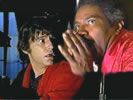
The latter duo make an excellent double act in The Cemetery, a good example of Serling piling on surprise after surprise. Vincent Price obviously enjoys himself as a master of black magic in The Return Of The Sorceror and is backed up with a nice underplayed turn by Bill Bixby.
The format is much the same as Twilight Zone, with Serling, dapper and urbane, strolling on to our screens to introduce the programme through clenched teeth. (Fashionistas should have a chilled glass of Chardonnay at hand. They will need it to steady their nerves when they first encounter his startling 70s bouffant hairstyle.)
A new twist, as the title suggests, is that the programmes are unveiled in an art gallery in which each painting (by artist Tom Wright) encapsulates the story that is to follow. Barnet malfunctions aside, Serling's intros are snappy, tight and to the point, a hallmark of his writing.
I always thought the intros were a pleasing flourish to both series and would quite happily watch a compilation. Serling was more than just a master of entertainment. He was a writer of note and amid the ghoulish and the ghastly, he squeezed in some serious comments on the human condition.
The series began to run out of steam after Serling's relationship with executive producer and fellow-writer Jack Laird began to go downhill. Laird, who partially redeemed himself writing episodes such as Professor Peabody's Last Lecture starring the great Carl Reiner, insisted on introducing disastrous short comic turns to the series. One such dire effort wasted Cesar Romero's talents in a vampire tale so obvious you can see the ending coming before you clicked on the starter graphic.
While the overall quality is not as high as the original Twilight Zone series, there are a number of must-see episodes. They're Tearing Down Riley's Bar is a masterful snapshot of a man whose world is crumbling around him, a study in pain, loss and vulnerability which rightly won a nomination for the Outstanding Single Programme on American television in 1971. William Windom's central performance as a man clutching at the straws of his past is gripping.
Eyes is to be noted as one of the earliest directorial ventures by Stephen Speilberg, who proved even at this early stage that he could do a lot with a little. Joan Crawford - in excellent bitchy form - stars as a wealthy woman, blind from birth, who wants her doctor to arrange an eye transplant. She is told that the only such operations have been performed on animals, and the transplant recipient's new vision only lasts for a matter of hours.
She is determined to proceed and finds a donor, a mug in dept to the mob who's prepared to part with his peepers for cash. She blackmails the doctor to go ahead with the op. Back home in her townhouse, Speilberg cranks up the suspense as she slowly reaches up to unravel the bandages around her eyes. Hands trembling, she unclips the final dressings and – damn, I've left a rice pudding in the oven!
Reviewed on: 02 Nov 2006



Director: Steven Spielberg, Boris Sagal, Barry Shear, Douglas Heyes, Jeannot Szwarc, Jerrold Freedman, Allen Reisner, John Astin, Jeff Corey, Walter Doniger, Richard Benedict
Writer: Rod Serling
Starring: Rod Serling, Vincent Price, Roddy McDowall, Carl Reiner, Diane Keaton, Lindsey Wagner, Sally Field, Joan Crawford, Ossie Davis, Tom Bosley, Larry Hagman, Burgess Meredith, Agnes Moorehead, Raymond Massey, John Astin
Year: 1970
Runtime: 195 minutes
BBFC: 
Country: US
Festivals:
Search database: