





Eye For Film >> Movies >> The Cave Of The Yellow Dog (2005) Film Review
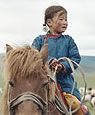


Whoever said: "Never act with children, or animals", understood the movie business. However, if you flip it audience-side up, you have the secret of success.
The Cave Of The Yellow Dog has children and animals coming out of its ears and will almost certainly become The Most Charming Film Of The Year at the end of term awards ceremony.
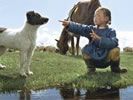
There is an added bonus in that it shows a way of life which is fast disappearing as the lure of the cities takes its toll on age-old traditions of nomadic herdsmen. By using a real family - husband, wife, two young girls and a toddler - writer/director Byambasuren Davaa (The Story Of The Weeping Camel) flirts with a documentary form against the vast magnificence of the Mongolian steppe. The imagery in this silent wilderness is reminiscent of 19th century North American paintings of the prairies.
When six-year-old Nansal finds a (suspiciously tame) young dog in a cave and brings it home, her father, fearing that it has been cohabiting with wolves, tells her to take it back. She disobeys and hides it amongst the goats in the corral.
Next day her father takes his motorcycle to the town to sell sheepskins and buy provisions. Nansal has time to play with Zochor (the name means Spot, not Rover) and one lowering afternoon, with black clouds threatening to break over her head, she loses him and, eventually, herself as she rides out in search.
The narrative is simple and occasionally sentimental. Their life appears hard, yet idyllic, with no visible signs of garbage, nor toilet facilities - what do they use for nappies? - and Nansal is always beautifully turned out.
The children are irresistible and Nansal Batchuluun's acting is naturally unselfconscious. The film is fascinating on many levels, both emotionally and cinematically, as well as exciting - will the vultures attack the toddler? Will Nansal find shelter in the storm? - and deeply affecting.
Reviewed on: 29 Jun 2006


Director: Byambasuren Davaa
Writer: Byambasuren Davaa
Starring: Nansal Batchuluun, Buyandulam Batchuluun, Babbayar Batchuluun, Nansalmaa Batchuluun
Year: 2005
Runtime: 93 minutes
BBFC: 
Country: Mongolia/Germany
Festivals:
Search database: