





Eye For Film >> Movies >> Fateless (2005) Film Review


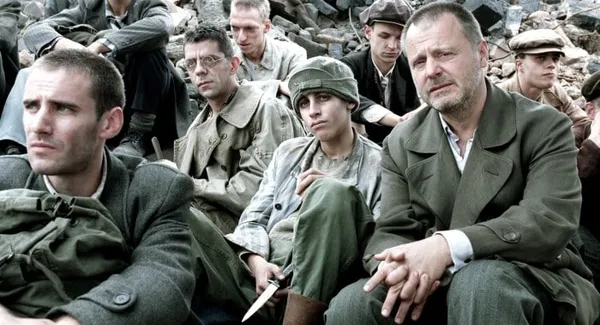

In Fateless (Sorstalansag), Nobel Prize winner Imre Kertesz adapts his 1975 debut novel, which was based on his teenage experiences as a survivor of the Nazi concentration camps. It is certainly a harrowing film, but not so much for the dehumanising brutality that it depicts as for the uncompromisingly rounded perspective of its narrator/protagonist.
Gyuri (Marcell Nagy), a 14-year-old Hungarian boy from an upper-middle-class family, rejects the easy comfort of reducing his experiences to mere victimhood, or "the common Jewish fate," preferring instead to recall, alongside his great suffering and personal disintegration in the camps, the moments of "happiness" and aesthetic rapture that he enjoyed there, as well as the occasional acts of great kindness that he encountered from fellow inmates and SS orderlies alike. Most provocative of all, once Gyuri has returned, alive if changed forever, to a Budapest that he barely recognises, he expresses what can only be called nostalgia for the camaraderie of the camps.

Holocaust films rarely make for comfortable viewing, but Fateless is all the more disconcerting for the manner in which its narrator attempts to "normalize" the horrors as part of the background of his rites of passage, a past that he accepts and embraces even as he looks with apprehension and dread to his future "freedom" in Communist Hungary.
As Gyuri is transported from a holding station at Auschwitz-Birkenau to the "more provincial" Zeitz ("Showers and crematoria were only in more important camps," he complains grimly) and finally to Buchenwald, his experiences seem no more ordinary than the death camp in Roberto Benigni's Life Is Beautiful (1997) seemed funny.
In cutting through the conventional cliches of Holocaust presentation to a more singular truth, Gyuri defies viewers to refuse him the license to tell his own story as he himself saw and felt it, rather than as others might prefer him to tell it. To refuse him this is to deny him his very identity and freedom, in circumstances where liberty is a precious commodity. In all its adolescent contrariness, Gyuri's self-account is the source of his empowerment and the mark of his emergence as an individual rather than a number.
If Gyuri is arrogant, cold and not particularly likable, it is these very characteristics that serve to confound our preconceptions of the typical Holocaust "victim." Most of all, though, he is disarmingly honest. He may have wept at the departure of his father (Janos Ban) for the labour camps, but his dispassionate voice-over reveals that he was not sure whether the tears resulted from genuine emotion, exhaustion, or just what he felt was an appropriate and expected response at the time. By the end, he will stop conforming to what other people expect of him, declaring to a well-meaning stranger that he feels only "hatred" in returning to his home town, and brusquely reminding his neighbours of the regrettable comments they had made years before.
Nagy plays Gyuri with an aloofness that is almost otherworldly and, as he slowly loses the will to keep living in the camps, he seems physically to waste away into nothingness before our eyes. It is a mesmerising performance, exposing the depths of human misery while stripping it of all sentiment.
Accompanying Gyuri's transformation from healthy, confident teenager to gaunt ghost is a corresponding shift in the visual palette, with the warm colours of the film's initial domestic scenes gradually leeching away to a near monochrome. Yet, as a reflection of Gyuri's unconventional perspective on his Holocaust experiences, director Lajos Koltai, better known for his cinematography on many of Istvan Szabo's films, has broken a cinematic (as well as ethical) taboo by including several scenes in the camp that have an undeniable, if austere, aesthetic pleasure to them.
It is the troubling paradox at the film's core, that anything, no matter how terrible or inhumane, can have its own beauty, at least for those who have eyes to see it.
Reviewed on: 05 May 2006



Director: Lajos Koltai
Writer: Imre Kertesz, based on the novel by Imre Kertesz
Starring: Marcell Nagy, Aron Dimeny, Andras M. Kecskes, Josef Gyabronka, Endre Harkanyi, Daniel Craig
Year: 2005
Runtime: 140 minutes
BBFC: 
Country: Hungary/Germany/UK
Search database:
