





Eye For Film >> Movies >> Life And Nothing But (1989) Film Review

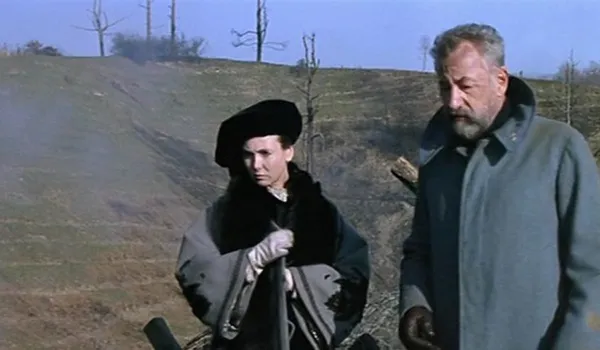

The aftermath of war is littered with loss. Bodies lie unclaimed, unrecognisable. Mothers, wives, sweethearts search for a sign in crowded country hospitals of life, of death, even a maimed torso, or shell-shocked brain that belongs to the man who marched away, with ignorance and pride, so many years before.
By October 1920, France is beginning her slow recovery. Trains are running again, even if stations are in ruins. Farmers find unexploded bombs under the blades of their ploughs. The sight of Arabs and Asians in the fields, helping the army, is not uncommon.
Bureaucrats and politicians have begun the nationalistic revival. Sculptors are in demand to create elaborate monuments to the memory of every fallen hero from every village in every district. Investigators are out looking for the corpse of an unknown soldier, to rest forever under the Arc de Triomphe, as a symbol of... what? Glory?
The feeling of tenuous control and haphazard order filters down to those whose security has never been restored. A young teacher loses her job when a qualified veteran from the front returns. Carriages of Red Cross wounded are blown up in a tunnel, still booby trapped from the period of the German retreat.
Life is balanced between luck, circumstance and privilege. Everything has changed and yet everything remains the same. The military represents law and order, as expected, while, beneath that uniformed facade, a beautiful chaos is attempting to corrupt truth.
Major Dellaplane (Philippe Noiret) has seen too much horror to respect the organisations that condoned it. His job is to discover the identity and fate of 350,000 missing men. He takes the ethics of what he does seriously and treats the rest with disdain, or gentle mockery.
When an aristocratic lady from Paris (Sabine Azema) appears, seeking knowledge of her husband, the Major is intrigued, annoyed and eventually infatuated. Their love affair, which is not a love affair, weaves through the centre of this broad canvas, never dominating, hardly announcing its intentions.
From such muddy, grey-toned, misty material, Bertrand Tavernier has crafted a magnificent piece of work, so clear of sentiment, so rich in irony, enormously enhanced by Noiret's sensitive portrayal of an old soldier, sickened by protocol, shy of emotional response and locked into the dignity of a disciplined sense of self.
Reviewed on: 05 Mar 2006



Director: Bertrand Tavernier
Writer: Jean Cosmos, Bertrand Tavernier
Starring: Philippe Noiret, Sabine Azema, Pascale Vignal, Maurice Barrier, Francois Perrot, Jean-Pol Dubois, Daniel Russo
Year: 1989
Runtime: 135 minutes
Country: France
Search database:
