





Eye For Film >> Movies >> Down By Law (1986) Film Review



With Jim Jarmusch's forthcoming Broken Flowers arriving at cinemas in the near future, fans of the left of field indie director would do well to check out his extensive back catalogue, newly released on DVD. Along with classics such as Mystery Train, he made several lesser-known hip low budget comedies in the Eighties, such as Down by Law. It's an eccentric film in the same vein as Night On Earth and Coffee And Cigarettes; dark, daft and lacking any particular point. It simply mellows in its own coolness.
Here, Jarmusch slams three very different convicts together in the same cell; Zack (singer/songwriter Tom Waits), the washed up radio DJ who has resorted to petty crime, Jack (John Lurie), the small time pimp, and Bob (Roberto Benigni), the thoroughly peculiar Italian, who has apparently killed a man with a snooker ball. Eventually, the three become friends and Bob hatches a plan of escape.
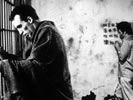
This is no prison breakout film, however - the trio escape with the greatest of ease, not that we are shown how - rather the problem is finding a way back to civilization after becoming lost in the everglades that surround the jail. Indeed, the most amusing scenes take place within the confines of the cell itself. Bob, as the slight, oddball foreign tourist, who somehow killed a man, is a fish spectacularly out of water next to tough guys Zack and Jack, and his bizarre pattering, interjected with even weirder questions ("Do you like Walt Whitman?") is a hilarious delight.
If the film has a flaw, it is structural. Jarmusch, it seems, is more capable of penning witty dialogue and bizarre scenarios than constructing a flowing narrative and Down By Law feels a bit stilted, divided as it is into three separate parts; the night of the arrests, during which Bob barely appears, cell life with gags and escaping through the marshes. You can argue that the whole point of indie filmmaking is the option to eschew such conventions, but nevertheless you can't help but feel that the film is simply three loosely connected comedy sketches, albeit thoroughly entertaining ones.
The photography is superb. New Orleans has always had a distinctive feel in films (will it any longer, one wonders, sadly) and this is no exception. Cinematographer Robby Muller evocatively captures the Cajun atmosphere of the sizzling night, the long shadows and flickering electric streetlights, contrasted in black-and-white with the intense claustrophobia of the everglades.
Reviewed on: 18 Oct 2005



Director: Jim Jarmusch
Writer: Jim Jarmusch
Starring: Tom Waits, John Lurie, Roberto Benigni, Nicoletta Braschi, Ellen Barkin, Billie Neal
Year: 1986
Runtime: 107 minutes
BBFC: 
Country: US/Germany
Festivals:
Search database:
