





Eye For Film >> Movies >> Appleseed (2004) Film Review



In a year that sees the UK cinema releases of Mamoru Oshii's existential future noir Ghost In The Shell 2: Innocence and Hayao Miyazaki's inventively surrealist fairytale Howl's Moving Castle, both of which set towering standards for the possibilities of animated narrative, all other feature-length animes seem doomed to a critical death by comparison.
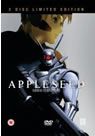
Yet Shinji Aramaki's Appleseed comes with a similar pedigree to Oshii's cyberpunk headscratcher - both are based on popular mangas by Masamune Shirow - and even if, at times, it is overburdened by a concern to retain the attention of teenage males, with lines such as "For a legendary soldier, she's awful cute when she sleeps," there is no denying the stunning quality of its visuals and Machiavellian twists in its plotting.

The year is 2131. Plucked from an endless global war that has reduced the world to ruins, female guerrilla fighter Deunan Knute is recruited into the military defense force of Olympus, a shimmering utopian city, model for a fair and peaceful society. There she is reunited with her former lover Briareos, now half-man/half-cyborg, and sees for herself the delicate equilibrium, where human citizens are kept from their more destructive urges by the Bioroids, a new species genetically altered to have limited emotions.
As a protective measure to ensure their co-dependence on humans, Bioroids are unable to reproduce, and Gaia, the giant computer network that regulates their behavior, is only allowed to reach its decisions in consultation with seven human elders. Yet, as a series of terrorist strikes threatens this balance, Deunan must race against time to work out who is behind the attacks and decide whether activating the so-called "Appleseed" data, designed to restore full reproductive capability to the Bioroids, will re-open the gates of paradise for humans as well as their modified relatives, or see them fallen and banished forever.
Although cinema neither can, nor should, pretend to be hard philosophy, the viewer who abstracts away from the more adolescent elements of plot will find that Appleseed has plenty of ideas at its core to keep the mind stimulated. It uses its sci-fi frame, inspired largely by Blade Runner, to stage the ethical conflicts between nature and nurture, biology and technology, emotion and reason, utopia and prison, self-preservation and self-destruction and the moral complexity of these issues is reflected in the labyrinthine complexity of the film's plot, crammed with double/triple crossing machinations and political maneuverings. The eyes, meanwhile, can feast on its photo realistic CG backgrounds and its characters, whose typical hand drawn manga look is combined with sophisticated synthespian motion-and expression-capturing technology, which neatly corresponds in visual terms to the film's thematic concern with artificial hybrids and human enhancements.
Unfortunately, even if it takes several motion models, an action model, a facial model, a voice artist and a whole team of 2D and 3D animators to realise each of the major characters, none of this suffices to cover their essential one-dimensionality, not helped by some of the film's more cheesily cliched dialogue ("What's it like to be in love?"). It is true that more than half the characters are emotionally neutral Bioroids and one is a cyborg, but thanks to poor writing, even the all-human protagonist Deunan seems as robotic as the rest.
It is virtually impossible to engage with these characters' predicaments on any personal level, but if these dramatic shortcomings are too considerable to be overlooked, the film's exquisitely rendered imagery and convoluted speculations cannot fail to impress.
Reviewed on: 20 Aug 2005



Director: Shinji Aramaki
Writer: Haruka Handa, Tsutomu Kamishiro, based on the manga by Masamune Shirow
Starring: voices of Jennifer Proud, James Lyon, Mia Bradly, Lee Rush, Michael McConnohie, Cindy Robinson, David Lelyveld, William Frederick, Ray Michaels, Russell Thor, Doug Stone, Frederick Bloggs, Michael Sorich, Kim Strauss, Steve Kramer, William
Year: 2004
Runtime: 105 minutes
BBFC: 
Country: Japan/South Korea
Festivals:
Search database:
