





Eye For Film >> Movies >> The Longest Day (1962) Film Review


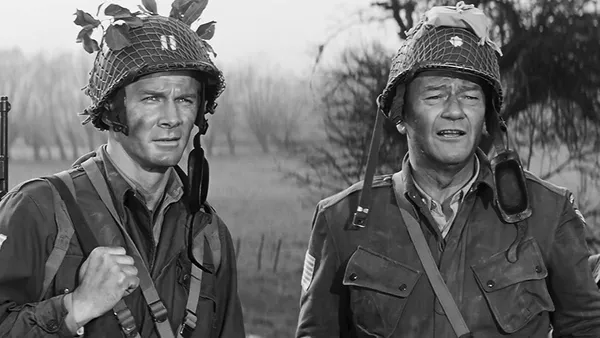

The Longest Day is largely a three-tier film, with threads of story leading up to the fateful events of D-Day, June 6, 1944. It bites off a lot of stuff, dealing with the planning of various objectives, diversions, military strikes and those famous beach landings. We are introduced to a multitude of characters and the epic scope of the film is evident, with a cast of thousands, even from the outset. The film is comprehensive and with an eye for detail.
Despite its multiple threads, it is overlong, with too much fat hanging off the narrative, becoming bogged down early in tedious exposition, when it should be pushing forward relentlessly, as the tension and drama builds.
It is a film intended as entertainment and, to some degree, succeeds. Once it gets going, the accrued momentum delivers well. The combat scenes are effectively staged, with no confusion as to the strategy of various engagements, since the geography is quickly and effectively driven to the audience.
The story cuts between multiple invasion attempts, bringing many of them to life. An especially brilliant moment is where 5000 ships open fire on the Normandy beaches to the gasping horror of the Nazi leader and obvious glee of a local Frenchman, who cackles with joy, even as his house is being demolished around his ears. Another horrifying moment is when a German pilot strafes a beach full of Allied forces and rips apart scores of soldiers through withering machine-gun fire.
Comparisons with modern war movies, such as the dizzyingly intense Saving Private Ryan, are inevitable, but, given the fact that films in the Sixties couldn't deliver the gruelling gore quota, nor had the medium's manipulation been widely and experimentally toyed with enough to deliver a technical and cinematic impact worthy of combat, this is no fault of the film.
Another prominent aspect of The Longest Day is that almost every two minutes a major star makes an appearance. Richard Burton, who delivers smashingly sourfaced dialogue superbly, Sean Connery, John Wayne and a string of other famous faces continually draw attention away from the business in hand. None of them embody their roles enough to convince me to suspend my disbelief, in spite of the visual impact of the cinematography.
The film was directed by three hired hands (Ken Annakin, Andrew Marton, Bernhard Wicki), who shared much of the work with the legendary producer Darryl F Zanuck, to whom this picture was an obvious pet project. His money is on the screen with enormous sets, highly competent Oscar-winning visual effects, showing fleets of planes, boats, rear projection, apropriately cunning rubber paramilitary personnel and epic widescreen photography.
The opening shot is in the barracks, where a game of craps is in progress, and the camera moves backwards, all the way through the building, exposing hundreds of soldiers, preparing for the invasion. Indeed, it looks great, a normal contrast with grey whites and rich inky blacks (I understand there's a computer-coloured version doing the rounds, which to me is like paint-by-numbers with digital crayons. Avoid!).
Disappointingly, since it has multiple directors and styles, the film shares a disjointed narrative and the binds between the various threads are all too visible. Also, it crumbles under it's own epic intentions and lack of cohesion.
Because of the film's achievements, I cannot help but feel that it could have been considerably better, given a tighter focus, more stringent editing, brought together under one vision. I'm a firm believer in the auteur theory, that sole authorship is essential to success.
It would be foolish to argue that since the film is leaden with exposition and presented in glorious black-and-white, it should be taken as a document of what happened. By contrast, it is quintessentially romantic. Note the opening empty helmet shot, the stirring military music and occasional Beethoven's 5th drum-and-string motifs.
An obviously expensive, lush production, an ambitious tribute to those lives lost by the Allies, The Longest Day spreads itself too widely for my taste, although, when it works, it's splendid.
Don't expect anything more than a solid Bank Holiday diversion, that's all.
Reviewed on: 02 Jul 2004


Director: Ken Annakin, Andrew Marton, Bernhard Wicki, Darryl F Zanuck
Writer: Romain Gary, James Jones, David Pursall, Cornelius Ryan, Jack Seddon, based on the book by Cornelius Ryan
Starring: John Wayne, Robert Mitchum, Henry Fonda, Robert Ryan, Sean Connery, Rod Steiger, Mel Ferrer, Robert Wagner, Eddie Albert, Edmond O'Brien, Richard Burton, Kenneth More, Peter Lawford, George Segal, Richard Todd, Red Buttons, John Gregson, Leslie Phillips,
Year: 1962
Runtime: 189 minutes
BBFC: 
Country: US
Festivals:
Search database: