





Eye For Film >> Movies >> Rashomon (1950) Film Review


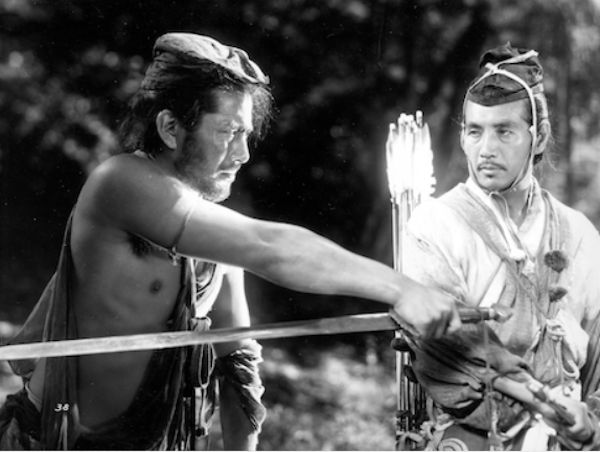
The simplicity of the idea disguises its serious intent. What is truth?
In medieval Japan, a wealthy traveller is killed in the forest. A local bandit is picked up and charged with his murder. Four separate versions of the incident are shown, each with an opposing outcome. Which is right? Who is guilty?
This is the film that introduced the West to Japanese cinema in 1950. It caused a sensation at Cannes, where it collected the top prize, and later went on to win Best Foreign Film at the Oscar ceremony.
Akira Kurosawa's imagery is startling. In the opening shots, the rain lashes down with unnatural force. Figures shelter under the protection of what looks like the ruin of a monumental edifice. The woodcutter tells the story of the traveller's death. Afterwards other versions emerge.
The style of the acting accentuates the drama in a way that must have appeared exaggerated to Western eyes. No one had experienced anything like Toshiro Mifune's wild energy. He plays the bandit as if imitating an angry chimpanzee, making faces and laughing like a crazed loony. The final sword fight between the bandit and the traveller is pure farce.
Machiko Kyo, as the traveller's wife, performs with a passion that Celia Johnson would find excessive. Kurosawa's interest was never in realism. For him, cinema is a visual medium and exaggeration enhances drama, like Noh theatre. In 1950, such powerful expression was almost frightening in its intensity. Even now, the hairs rise at the back of the neck.
Reviewed on: 22 Dec 2001


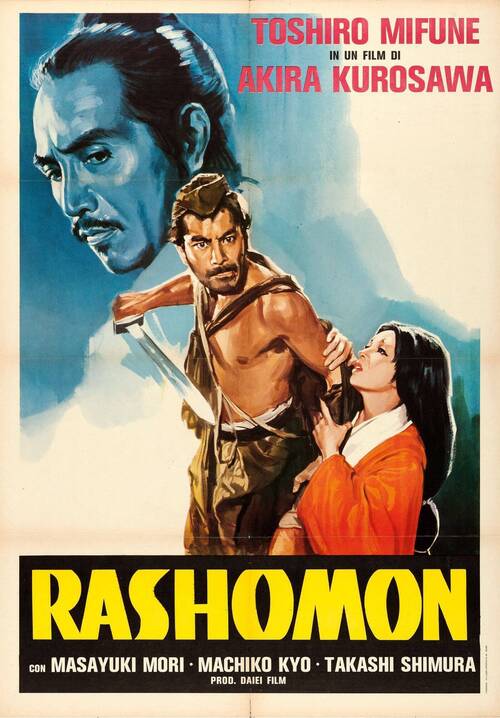

Director: Akira Kurosawa
Writer: Shinobu Hashimoto, Akira Kurosawa, based on a short story and novel by Ryunosuke Akutagawa
Starring: Toshirô Mifune, Machiko Kyô, Masayuki Mori, Takashi Shimura, Minoru Chiaki, Kichijiro Ueda, Fumiko Honma, Daisuke Katô
Year: 1950
Runtime: 86 minutes
BBFC: 
Country: Japan
Streaming on: Arrow
Search database:
