





Eye For Film >> Movies >> Mad City (1997) Film Review

What does "Mad City" say to you? Kooky cops? Corruption on a mental health sub committee, leading to the release of criminally insane inmates? A teen musical about aliens competing at the amusement arcade's video games final?
Costa-Gavras' film suffers twofold. First its title and second its plot. Dog Day Afternoon started something all those years ago, because hostage situation movies are coming out of the woodwork (Mr Reliable, Best Men) and almost every event picture these days takes a dig at TV journalism (Deep Impact, Godzilla). Mad City is a hostage situation movie that takes a dig - more like a punch - at TV journalism.
Despite same old same-old, the performances are interesting, the attack on media integrity spot on and the sentiments sweet as strawberry shortcake. Having Alan Alda as backup is always a clever move. He can do the funny stuff to perfection (Flirting With Disaster) and be nasty, too (Murder At 1000). When he's nasty, you feel it. He's nasty here. He plays Kevin Hollander, a veteran TV anchorman, locked onto the main chance like a heat seeking rocket.
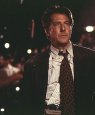
He and Max Brackett (Dustin Hoffman) used to work together before Brackett blew it live at an air crash site when Hollander's needling insensitivity pushed him over the edge. Now Brackett is back where he started, doing parochial stories for a local station in Dullsville.
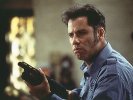
When covering an item on museum funds, he finds himself in the men's room when a guy with a gun (John Travolta) starts haranguing the curator (Blythe Danner) and scaring a party of kids who happen to be on a school outing. The gun goes off by mistake, injuring a security guard outside. Hell, in the form of cops, TV, press, FBI, is let loose.
Sam Baily, the guy with the gun, is the other security guard, the one who was made redundant, due to financial cuts. He has a wife, a mortgage, a low IQ and two children. He can't cope. He comes armed to force the curator to listen. He brings dynamite, too.
The film shows how TV handles this story, which, by now, has escalated into a network bonanza, with the injured guard fighting for his life in hospital and the parents of the children panicing and enraged. Max, being inside the museum, gains Sam's confidence. He recognises that the whole thing has been a mistake. Sam is an innocent, caught up at the centre of what has become a media circus. Max is the key. You don't know whether he's exploiting Sam for his own ends, or genuinely looking after his interests. It becomes clearer as the crisis moves on.
Hoffman plays tight, like the best poker player, concentrated and inscrutable. Travolta stays with him, a little mannered maybe, a little gammon with the salad, but always committed. It's good to see him stretch into areas you don't expect to find him. The film suffers from covering known territory. It exposes the moral vacuity and ruthless ambition of TV journalism to the point where truth is cut to fit, like an editing job.
Reviewed on: 19 Jan 2001


Read more Mad City reviews:
| Keith Hennessey Brown |   |
Director: Costa-Gavras
Writer: Tom Matthews, Eric Williams
Starring: John Travolta, Dustin Hoffman, Alan Alda, Mia Kirshner, William Atherton, Raymond J. Barry, Ted Levine, Robert Prosky, Blythe Danner
Year: 1997
Runtime: 114 minutes
BBFC: 
Country: US
Festivals:
Search database:
